Monday, January 21, 2019

patchwork and piece

CA summer
"The choice of occupation, that is, of [Pierre's] way of life—now that that choice was so restricted—seemed to him such an easy matter that he forgot that a superfluity of comforts of life destroys all joy in satisfying one’s needs, while great freedom in the choice of occupation—such freedom as his wealth, his education, and his social position had given him in his own life—is just what makes the choice of occupation insolubly difficult, and destroys the desire and possibility of having an occupation" (1090).


$quirreling
"There had been the extraordinary autumn weather that always comes as a surprise, when the sun hangs low and gives more heat than in spring, when everything shines so brightly in the rare clear atmosphere that the eyes smart, when the lungs are strengthened and refreshed by inhaling the aromatic autumn air, when even the nights are warm, and when, in those dark warm nights, golden stars startle and delight us continually by falling from the sky" (935).


grateful for this day: 11/22/18
"On the tray was a bottle of herb-wine, different kinds of vodka, pickled mushrooms, rye-cakes made with buttermilk, honey in the comb, still mead and sparkling mead, apples, nuts (raw and roasted), and nut-and-honey sweets. Afterwards she brought a freshly roasted chicken, ham, preserves made with honey, and preserves made with sugar" (546).

"When an apple has ripped and falls, why does it fall? Because of its attraction to the earth, because its stalk withers, because it is dried by the sun, because it grows heavier, because the wind shakes it, or because the boy standing below wants to eat it?
Nothing is the cause. All this is only the coincidence of conditions in which all vital organic and elemental events occur. And the botanist who finds that the apple falls because the cellular tissue decays and so forth, is equally right with the child who stands under the tree and says the apple fell because he wanted to eat it and prayed for it" (650).


Life of Yuki, graduation day:
"But hard as they worked till quite late that night,
they could not get everything packed" (919).

"Pierre felt himself to be an insignificant chip fallen
among the wheels of a machine whose action he did
not understand but which was working well" (1035).
do u ever feel like a plastic bag

Said small unit: mouse that lived for 24 hours in trap.
Unlatched and put outside with a peanut.
"Go make some mighty mice."
"The movement of humanity, arising as it does from innumerable arbitrary human wills, is continuous…Only by taking an infinitesimally small unit for observation (the differential of history, that is, the individual tendencies of men) and attaining to the art of integrating them (that is, finding the sum of these infinitesimals) can we hope to arrive at the laws of history" (881).


Scattering of light over snow
"Q = mL, where Q is thermal energy in Joules, m is mass in kg, and L is latent heat!" -Ms. Breck 
"A lump of snow cannot be melted instantaneously. There is a certain limit of time in less than which no amount of heat can melt the snow. On the contrary the greater the heat the more solidified the remaining snow becomes. Of the Russian commanders Kutuzov alone understood this" (1108), and that's why this happened: 
"Charles Minard's 1869 chart showing the number of men
in Napoleon’s 1812 Russian campaign army, their movements,
as well as the temperature they encountered on the return path."
As seen in the beloved book by Tufte!


Love You Forever by Robert Munsch
"Physical and spiritual wounds alike can heal completely only as the result of a vital force from within. Natasha’s wound healed in that way. She thought her life was ended, but her love for her mother [and father] unexpectedly showed her that the essence of life—love—was still active within her. Love awoke, and so did life" (1162).


nesting desktops
“'Yes, in our time it would be hard to live without faith…' remarked Pierre" (1199).
great article from Dad: "Tolstoy reminds us that to be a Christian is to be a fool and a social outcast, that anyone who wishes to follow Christ has to be prepared to die as an enemy of the state, nailed to the cross. It’s a little bit more than a few verses of "Shine, Jesus, Shine" on a Sunday morning. So don’t think of War and Peace as just some Russian Downton Abbey, full of distracting eye-candy. Not that Tolstoy was averse to the sins of the flesh. Like Count Pierre Bezukhov in War and Peace – who is a thinly veiled self-portrait of Tolstoy himself – his pilgrim’s progress begins in the brothel, and proceeds via a commitment to religious organizations... to a simple inner commitment to the will of God. This faith only has one commandment: love God and love one other – yes, that’s only one commandment because the latter is a consequence of the former. And this commandment will get you into trouble."


Italo Calvino via Stephen Donadio: “A classic is a book that has never finished saying what it has to say.” I finally know what you mean, Professor, when you said that readers of War and Peace never want it to end.

Monday, November 26, 2018

note to self: matthew 7:13-14

Enter by the narrow gate. For the gate is wide and the way is easy that leads to destruction, and those who enter by it are many. For the gate is narrow and the way is hard that leads to life, and those who find it are few.

你們要從窄門進去;因為那通向滅亡的門是大的,那條路是寬的,從那裡進去的人也多; 然而,那通向永生的門是多麼小,路是多麼窄,找到它的人是多麼少。

sorta rfrosty

world is freezing but heart is defrosting

Friday, September 7, 2018

the theory of everything, watched four times in two days

Yuki and I passed by Midd two weekends ago,
accidentally turned back the clock
Net sorrow, but that particular kind of sunset...
I lost my voice after a week of "teaching" and sounded like Marge Simpson so I decided it would be sufficient to show The Theory of Everything as a time-killing tactic these past two days of class (sorry sorry students and sorry to parents who pay so much—it's relevant to the course I promise—or at least establishes intrigue). I first saw this film <4 years ago over Christmas break and remember bawling with Cherry in the cushy Pruneyard Shopping Center theater. Melodramatic bits (Stephen and Jane nuzzling) notwithstanding, the students did detect that while physics does a fair job of predicting behavior of phenomena both extraordinarily large and also sub-atomic in size, the "human-sized happenings—cream going into a coffee cup, [the miraculous marriage of Stephen and Jane]—remain a mystery" (à la Tom Stoppard's Arcadia!).

Turn back the clock! That's why I cried so much after this film—if only I could occasionally turn back the clock! It's pointless and poetic, this notion of slipping through different values of t, in the way that Jane—when asked why she studies "medieval poetry of the Iberian peninsula"—answers Stephen that she likes to time travel, "just like [him]." Is that where literature and physics intersect, then? Or if not all types of physics, just cosmology? GR? In an effort to turn back the clock?

Stephen and Jane—envoys of "Science!" and "Arts!"—converse so seamlessly that Jane's quoting Genesis to her atheistic companion as they gaze upon constellations doesn't sound the least bit corny. In the beginning, God created the heaven and the earth. And the earth was without form, and void; and darkness was upon the face of the deep. Maybe it sounded particularly fitting because of her very englishy accent. But even StephenEddie RedmayneHawking took her seriously in that moment, and so did my class.

(Aw! A dorm-daughter of mine just brought me a throat lozenge! It's a Friday night so some of the girls are coming back from the white-out dance with boys and I am enforcing the shoe-in-the-door rule and blasting music to block out any nuzzling noises.)

I leave you with the quotes from Arcadia, Merriam-Webster, and this film that linger after this first week of teaching. Percolating.

phys·ics 
ˈfiziks/
noun
the branch of science concerned with the nature and properties of matter and energy. 

“Relativity and quantum looked as if they were going to clean out the whole problem between them. A theory of everything. But they only explained the very big and the very small. The universe, the elementary particles. The ordinary-sized stuff which is our lives, the things people write poetry about – clouds – daffodils – waterfalls – and what happens in a cup of coffee when the cream goes in – these things are full of mystery, as mysterious to us as the heavens were to the Greeks.”  —Tom Stoppard's Arcadia   

"God doesn't play dice with the universe." —Einstein
"Not only does God play dice, but...  he sometimes throws them where they cannot be seen." —Hawking

"I have loved you. I did my best." —Jane Hawking, in the movie

Saturday, September 1, 2018

new vocab

These words populate my speech now:
Plattsburgh, PGs, advisee, Grape Nut custard, Subaru Outback, Tilton, Camp Mowglis ("mao-glee"), canoe!, seltzer, pour, ahh bad decision, Dollar General, Husky Nation, bleeding green, hemlock, white pines have five needles, birch!, blackbear, Nelly, Ludacris, Pilalas ("puh laww luhs"), HIIT, hell-ooo mister fluffy, how old's your baby?, the lake, the lake house, what lake is that, wicked [XYZ], Newton, 93 North, Worcester ("wuhster"), Concord Coach, yes I'll have a dumpling, "I'm Gl--Miss Breck!"

Who knew Grape Nuts could be made into a custard, utterly annihilating their teeth-annihilating ways?! Also, that NH has +-twice the population of and different soil than VT (resulting in ver-monty's fluffier greenery)?

Also, that no words are better suited to winning both hearts and cooperation than:
- What can I bake for you?
- Let's go to Dunks!

NEPSAC experience in a nutshell. Somehow bypassed the whole shebang at Midd.
Home's a good place, and so is here :)

Sunday, August 19, 2018

I'm here now—New Hampton edition

I just dropped a table on my big toe, but hey! I got it up fourteen carpeted stairs and am happily typing upon it at last. I have a lil nest all to myself in the woods of New Hampton, New Hampshire. The windows are open wide and I can hear, across the street, the most beautiful song blaring:
I miss home, one week into this new life. But if I had heard this at home it wouldn't have been half as beautiful. Not sure yet why I un-flocked to the place where people are indeed in motion and gentle.

dog-eared quote dump/book reports for recent grads!

"Summer is whizzing by at the rate that my mother's new Vita-Mix processes whole lemons"—the birth of this blog five years ago

So, let's fill it with the lines that sparked a corner-fold! Lest I forget them. It's been quite a nonthinking summer, full of wallowing. I am ready to write again. But first, the better words of others. You should read these books. Booko uno:

Hey hey, Ishiguro's debut novel!
Pg. 67:
"Excuse me, Father, but I must sleep. I have another busy day tomorrow."
Ogata-San looked up at his son, a somewhat surprised expression on his face. "Why, of course. How inconsiderate of me to have kept you up so late." (...) 
Jiro wished his father a good night's sleep and left the room. For a few seconds, Ogata-San gazed at the door through which Jiro had disappeared as if he expected his son to return at any moment. Then he turned to me with a troubled look.
"I didn't realize how late it was," he said. "I didn't mean to keep Jiro up."
Parents and adult children. It really hurts me somehow.

Pg. 49:
"Honestly, Mother, I don't know how you can sit and watch rubbish like that. You hardly used to watch television at all. I remember you used to keep telling me off because I watched it so much."
I laughed. "You see how our roles are reversing, Niki. I'm sure you're very good for me. You must stop me wasting my time away like that."
Again with the parents and their adult children. Strikes a chilly chord.

Pg. 32:
"Well, let me pack you a lunch-box, it won't take a minute."
"Why, thank you, Etsuko. In that case I'll wait a few minutes. In fact, I was hoping you'd offer to pack me lunch."
"Then you should have asked," I said, getting to my feet. "You won't always get what you want just by hinting like that, Father."
"But I knew you'd pick me up correctly, Etsuko. I have faith in you."
Daughters and their fathers-in-law. And the art of "picking one up correctly." Is it universal?

Pg. 89: "Mother, you're always so obsessed with how old people are. It doesn't matter how old someone is, it's what they've experienced that counts. People can get to be a hundred and not experience a thing." 
Just because we seem to be having this debate around the house, all the time. Contestants: my death-defying dad, gracefully-aging mom, and the Confucian-Christian me.

Pg. 115: "Maths sharpens children's minds. You'll find most children good at maths are good at most other things. My husband and I had no disagreement about getting a maths tutor." 
Not sure why I dog-eared this guy—perhaps my existence refutes this. I feel like I ceased to be good at anything since starting physics. But yaknow some days are better.

Pg. 118: [Words of advice to a pregnant lady] "And it's an idea to let the child hear a lot of good music," the woman was saying. "I'm sure it makes a lot of difference. A child should hear good music among his earliest sounds." 
Again, I hope this is where the story—according to nytbookreview—sits squarely and strictly between elegy and irony.

Other summertime reads, all short and sweet and mildly instructive:

Note on the Hemingway: Sheds some light on Jess from Gilmore Girls. Also, contains the following: "For a poet, he threw a very accurate milk bottle." 

Tuesday, May 22, 2018

senior project quilt: while we may fear the day that physics explains aesthetics in full...


Fourier Analysis of Frequencies, Ascertaining Anharmonicity, and Explorations of Equal Temperament in The Well-Tempered Clavier. Abstract: After centuries of deliberation, equal temperament (a system of piano tuning wherein frequencies progress by a factor of the twelfth root of two) subverted Pythagorean conceptions of acoustical purity involving whole-number ratios. Soon after, Bach’s Well-Tempered Clavier—a work rightly deemed the “Old Testament,” or firm foundation, of piano repertoire—configured twenty-four pairs of preludes of fugues most ideally to the unequal temperament of his time. Interpreters ascribe synesthetic characteristics to each key (D major = burnished brassy gold, C = pure innocence of white, etc.), spurring this attempt to either dispel or affirm such arbitrary associations by verifying each piece’s optimal suitability to its given tonality. Following Fourier analysis of natural frequencies, I outline the extents to which stretched tuning and anharmonicity affect aural perception, and also provide preliminary confirmation that these pieces are indeed imperceptibly transposable amongst all keys on equally-tempered keyboards.

Piano temperament, or “the adjustment of intervals in tuning a piano or other musical instruments so as to fit the scale for use in different keys,” is analogous to ikebana (Japanese flower arrangement) in its dependence on balance and taste

Guys who did the groundwork, from upper then lower left: Pythagoras (b. 570 BC), Euclid (b. 325 BC), Gioseffo Zarlino (b. 1517), Zhu Zaiyu (b. 1536), Simon Stevin (b. 1548), Descartes (b. 1596), Daniel Bernoulli (b. 1700 AD), and Rameau (b. 1683)
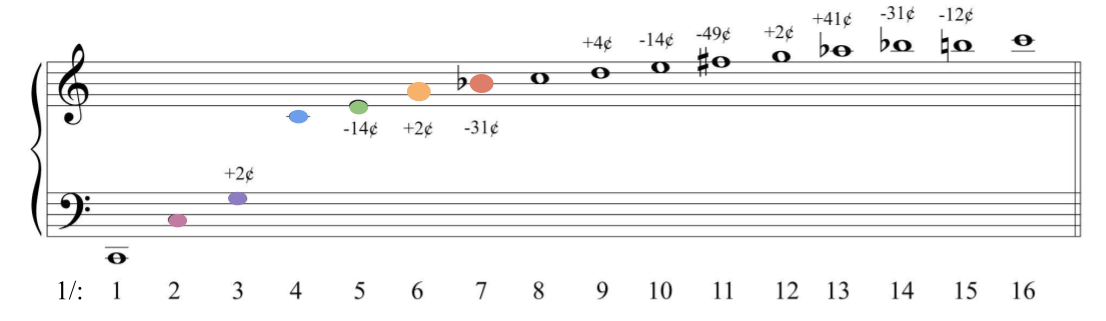
Infinite overtones can be derived from the fundamental, providing endless harmonic color.
Sustaining the fundamental (1/1) on a piano at a loud dynamic permits one to hear the overtones more clearly. Notice how the higher overtones include discordant notes. The “cents” are equal to one-hundredth of a semitone.

Musical frequency, pitch, keyboard, interval, and notation relation chart.
The table above corresponds to the intervals named right above it.

Railsback piano stretch, which is an average deviation from equal temperament amongst 16 different pianos (Martin and Ward, 1961). These deviations are tiny but perceptible!
Mathematica does all Fourier transforms for me, which is lovely because I'm still not quite sure how to do them by hand... :) Here, its squeezes out a dominant frequency (in Hz) from 100,000 sample points collected using Audacity.
The black lines illustrate the deviations of Mead Chapel's piano's "A"s from what they are predicted to be by the twelfth root of two. Notice that A3, A4, and A5— which are near the center of the keyboard—align fairly well with their nominal frequencies.
Determining consistent values for anharmonicity (non-Hookean motion in an otherwise simple harmonic system) for the fundamental frequency and a few of its overtones.
some visualizations of what it means to transpose WTC Prelude No. 1 in C Major to other major keys. The interval sizes do indeed contract and expand in slightly significant ways, suggesting that yes, C Major is the best "home" for this piece!
Another juxtaposition of interval-progressions in twelve major keys. See how some in the back are taller than those in the front. Though we can see the height disparity, our ears likely can't hear the difference.
Another attempt to point out differences in interval progression-shape. G Major, the key located "farthest" from C on the keyboard, displays the greatest deviation. Again, we probably can't hear it, so the implications of this finding are nil, I'd say.
While we may fear the day that physics explains aesthetics in full, we have much to glean from the aspects explained in part.

In summary.