Tuesday, May 15, 2018

no nymphets to play with: only words

case in point
{dis var fun 2 rite}

Journalism professor John McPhee, who is at last finishing Lolita via in-vehicle audiobook, muses that “Nabokov is a precursive rapper. He’ll go: ‘I went into the room and ruminated.’ He’ll have line rhymes that go on and on, and alliterations that go on and on, and alliterative line rhymes out the door. He’s verbally intoxicated” (“What I Think: John McPhee”). Indeed, the writer, professor, and lepidopterist Vladimir Nabokov churns out prose with ecstatic, effortless musicality, which in fiction is tasty but in cover letters utterly unpalatable. Fie on cover letters: clear, communicative, functional writing of the kind valued by consulting firms negates the sounds and shapes of words, and fears the spectrum of meanings permitted by their interactive shimmering. Thus, near-poets like Nabokov write in retaliation to the sparest systems of speaking and writing; though he has “only words to play with,” bland old objective reality is at the whim of the sound bites comprising Lolita.

Practical people—professional, respectable people—resent such voices because they force listeners to think twice about what was just heard or read. Forced to revise their thoughts for clarity, writers rush to defend their beloved twists and turns of phrase, gesticulating wildly at inside jokes and misfired puns, and insisting that any unintelligibility is deliberate. Such writing tends towards excessive Romanticism, like piano students with overly-pliant interpretations of already-cheesy Chopin. Rhythmic prodding—or rubato, code for “stolen time that ought to be returned”—exemplifies romanticism: the attempt to manipulate and, on occasion, obliterate time. Nabokov manages literary rubato by squelching every possible detail from an otherwise trivial moment: Lolita’s leading man Humbert Humbert observes “on her brown shoulder a raised purple-pink swelling (the work of some gnat) which I eased of its beautiful transparent poison between my long thumbnails and then sucked till I was gorged on her spicy blood” (156). Readers did not know that they wanted to know this, and marvel at Nabokov’s skillful neutralization of the grotesque. The following snippet similarly affirms that romanticism is really just verbal dilly-dallying: Humbert spots “a [fire] hydrant: a hideous thing, really, painted a thick silver and red, extending the red stumps of its arms to be varnished by the rain which like stylized blood dripped upon its argent chains” (106). By lingering on the unappetizing nubbins and knobs otherwise evicted by verbal economy, Nabokov demonstrates the power of rubato to hypnotize his audience. Half his adjectives could certainly be eliminated or compacted in the name of concision, but we would be experientially poorer for it—perhaps the masterful dearth of adverbs in these two segments contributes to their success. Blood has never oozed so appealingly from a ripe cyst.

These two moments are relatively unambiguous in the field of Nabokov’s figurative devices—readers later wander so far into the thicket of meanings that Nabokov succeeds in rationalizing Humbert’s carnal passion for a twelve-year-old. In class, we ascertained that in clinical language—Blanche Schwarzman, black-and-white language—HH sexually abused a young girl—“broke her life” (279)—and that’s that. How is it, then, that Nabokov makes readers like Humbert, or that Humbert makes readers like Humbert, or Humbert makes readers like Nabokov? (The third is not so controversial—we are so awed by Nabokov’s virtuosity that we trust him.) Perhaps we like Humbert for his relatability, especially regarding vanity: he continually worries that he has not “sufficiently stressed the peculiar ‘sending’ effect that [his] good looks—pseudo-Celtic, attractively simian, boyishly manly—had on women of every age and environment…every once in a while I have to remind the reader of my appearance much as a professional novelist, who has given a character of his some mannerism or a dog, has to go on producing that dog or that mannerism every time the character crops up” (104). This is the rapper-ego at work. Continual celebration of oneself, especially of the more superficial aspects, pervades most entries on the Billboard Hot 100, and is symptomatic of a need for affirmation experienced by all and exploited by artists. To complete his case, Humbert dwells in ethical gray areas, admitting that “he knew, of course, it was but an innocent game on [Lolita’s] part, a bit of backfisch foolery in imitation of fake romance,” but nevertheless insisting that “the limits and rules of such girlish games are fluid” (113). Given the option to, Humbert optimizes: he is “in blood stepped in so far” à la Macbeth that he might as well continue with his sin, forming an advantageous interpretation of Lolita’s girlish inexperience. The skies nevertheless burn with hell flames.

In a more whimsical mode of manipulation, MC Nabokov-Humbert litters the pages with charming alliterations and puns, often risqué in nature. Here is a large sampling of most effective ones: the “Kumfy Kabins (117)” that dot Humbert and Lolita’s copulative interstate criss-crossing form a fine double-entendre if I ever heard one. The “noble nipple” (76) graces us with its amusing appearance as Humbert appraises his dummy-bride, Charlotte Haze. The following list demonstrates that Nabokov’s phrases, read in rapid succession, are of stunning sonic value: “a midget for mistress” (108), “a banked banker, so to speak” (98), American mountains that are “altitudinal failures as alps go” (156), “gangling, golden-haired high school uglies, all muscles and gonorrhea” (160), asking strangers for directions and receiving only “geometrical gestures, geographical generalities…well-meaning gibberish” (116). Should your eyes water, I will provide relief in the form of chilled stone fruits, pillowing Lolita’s eyes “as plumbaceous umbrae” (111) and appearing as sleeping pills: “much too precious was each tiny plum, each microscopic planetarium with its live stardust” (109). That HH so regards these purple pills—tools meant to facilitate the fondling of darlings—speaks to the almost holy consecration of his however-misdirected love for Lolita. He yearns to suntan in her fey, star-dusted presence; the pills afford possibilities to do so imaginatively. Upon their chipper arrival at The Enchanted Hunters, Humbert notes that “with a childish hand [Lolita] tweaked loose the frock-fold that had stuck in the peach-clef—to quote Robert Browning” (117). Now, is Humbert actually quoting the poet, or is he being cleverly Victorian with this creative characterization of the wedgie? Privately and blissfully, Humbert revels in his ripe, nubile ward. Nevertheless, when his consciousness nags, HH mishears “The weather is getting better’” as “Where the devil did you get her?” and “July was hot” as “You lie—she’s not” (127) (his daughter, that is). See how the mere sounds of words amplify their usage! Sketchy Humbert’s paranoia pollutes his perceptions of spoken words. Maybe, though, he heard correctly the first time.

Another very rapperly reference to procreation (however more delicately euphemized) commemorates Humbert and Lo’s first shared bed at The Enchanted Hunters. Think twice or you’ll miss it, for rather than detailing the proceedings with pornographic detail, Humbert writes, “Had the management of The Enchanted Hunters lost its mind one summer day and commissioned me to redecorate…There would have been poplars, apples, a suburban Sunday. There would have been a fire opal dissolving within a ripple-ringed pool, a last throb, a last dab of color, stinging red, smarting pink, a sigh, a wincing child” (134-135). “Smarting”—to cause a sharp, stinging pain. When considered in combination with the knowledge that “pride alone have prevented her [Lolita] from giving up” (134) during what’s revealed to be “strenuous intercourse three times that very morning” (140), one marvels at Nabokov’s novel coverage of the oft-mangled “stark act.” The story was not building up to this point, as originally surmised (…considering), but passes casually by on its merry way to portraying a love less technical and more ineffably pure.

As another means of comic relief, Humbert-Nabokov supplies parenthetical zingers with a knack for trivializing the tragic. Early on, he recounts the death of a parent: “My very photogenic mother died in a freak accident (picnic, lightning)” (10). Similarly, the death of Charlotte Haze merits the following note: “Within the intricacies of the pattern (hurrying housewife, slippery pavement, a pest of a dog, steep grade, big car, baboon at its wheel), I could dimly distinguish my own vile contribution” (103). These precisely-timed interjections contribute to the farcical, film noir, two-dimensional quality of Humbert’s recollections, suggesting that half of what he claims may have transpired only in his revisionist memory, if not imagination. When a motel manager tells Humbert that “one night we had three ladies and a child like yours sleep together. I believe one of the ladies was a disguised man [my static]’” (118), the parenthetical-within-a-parenthetical reminds the reader of Humbert’s creative omnipotence. Similar editors’ markings appear throughout his narrative, suggesting a meta-revision of reality for maximal effect.

Kiki Smith: “...your work shouldn’t be so idiosyncratic and
personal that people can’t find an entrance for themselves
into it, and it can’t be so general that they can’t see
what you have at stake in it.”
Vivian Darkbloom—a.k.a. Vladimir Nabokov—delights in the fungible permutations of a name. “Humbert” morphs most dynamically, beginning with “Mr. Edgar H. Humbert (I threw in the “Edgar” just for the heck of it)” (75) in his wedding announcement. No one thinks to question this inconsequential falsity. When filling out forms, HH deliberates: “What should I put? Humbert and daughter? Humberg and small daughter? Homberg and immature girl? Homburg and child? The droll mistake—the ‘g’ at the end—which eventually came through may have been a telepathic echo of these hesitations of mine” (109). This gestures to the impact of letter-by-letter revision: a tiny substitution has a disproportionately large effect, changing perhaps even the religious affiliation of the Hum-someone in question. His identity is slippery, as all signifiers are. Elsewhere, Humbert crafts a particularly appealing incarnation of Lolita (amongst Lo, Lola, Dolly, Delores): “Lo and Behold, upon returning, I would find the former, les yeux perdus, dipping and kicking her long-toed feet in the water” (162). These words at play—carefree, confident, knowing play—add to, rather than distract from, the clarity of prose. Still cleverer is the naming of Humbert’s dispensable lawyer, who “suggested I give a clear, frank account of the itinerary we followed…This is not too clear I am afraid, Clarence, but I did not keep any notes” (154). Clears and Clarences and similar pairings abound, winking at readers from their firmly-affixed, sneaky nooks on the page. These details sandwich, by the way, a decidedly un-clear account of Humbert and Lolita’s travels around the country.

Nabokov remixes narration and “found documents” to spin poetry out of once-empty words. Indeed, as pointed out in class, in Hum’s hands everything becomes a poem, just as for hammers any old thing becomes a nail. Humbert pairs the academic-seeming assertion that “in such stimulating temperate climates [says an old magazine in this prison library] as St. Louis, Chicago and Cincinnati, girls mature about the end of their twelfth year” with the realization that “Delores Haze was born less than 300 miles from stimulating Cincinnati,” artfully combining the facts to suit his questionable case. How conveniently and eloquently they meld in Humbert’s favor. In the first stages of his fervor for Lolita, Humbert collects and stashes tokens of her existence with gnomish attention, including verbal treasures of a verbal nature: “There was a mimeographed list of names referring, evidently, to her class at the Ramsdale school. It is a poem I know already by heart…A poem, a poem, forsooth! So strange and sweet was it to discover this ‘Haze, Delores’ (she!) in its special bower of names, with its bodyguard roses—a fairy princess between her two maids of honor…pretty Rosaline [Honeck], dark Mary Rose [Hamilton]” (52). This method of mountain-from-molehilling, purely aesthetic, endears Humbert to his listeners. The poetry positively flows out of tender Humbert, we say with a simper, pardoning his need to feed on nymphets as a side-effect of aesthetic hypersensitivity, a trait to be encouraged.

At what point does one take too much artistic liberty? Slightly-creepy multidisciplinary artist Kiki Smith recalls that when she was young, “a man told me that your work shouldn’t be so idiosyncratic and personal that people can’t find an entrance for themselves into it, and it can’t be so general that they can’t see what you have at stake in it” ("The Magic of Fall Fashion at the Venice Biennale: Kiki Smith"). Vladimir Nabokov sits at that ideal junction between obscurity and opalescence: a bit of persistent rubbing reveals literary gems worth pocketing. In fact, most of his writing glimmers at first glance. His verve for verbiage (though only of the most essential kind) electrifies each page of Lolita, rendering a story ripe for retelling, in person or on screen. If only the Wall Street Journal was written in such a way—I wouldn’t have to read each article five times before it penetrated my air-head. Perhaps this is the reason that literature rings more truly to the likes me of than nonfiction and news: memorably adorable thought-strings enmesh themselves into one’s CPU to stay.

Works Cited
Gebremedhin, Thomas. "The Magic of Fall Fashion at the Venice Biennale: Kiki Smith." Wall Street Journal Magazine, Aug. 2017.
Nabokov, Vladimir. Lolita. 2nd International ed., New York, Random House, 1955.
"What I Think: John McPhee." Princeton University News, edited by Jamie Saxon, www.princeton.edu/news/2017/09/18/what-i-think-john-mcphee. Accessed 20 Mar. 2018.

Monday, February 19, 2018

music and memory

Like love, there can never be too much “good music.” The number of people who use it as a fuel to recharge their appetite for life is beyond counting. —Haruki Murakami in conversation with Seiji Ozawa

musical memory of mine—Woodleigh, 2011
The experience is universal, but here are some particulars: hearing a jingle from childhood, then reminiscing on bygone innocence. Nodding along to the car radio with a college boyfriend, only to hear a slow-dance song from prom and recall another’s swaying hug. Lacing fingers with a fellow concert-goer at particular moments in a piece, wondering if such euphoria was mutually detected. Every romance owns a soundtrack, if not a series of turning points anchored in music; thus, the telling of love stories contains particular potential for musical metaphor. In The Kreutzer Sonata, Tolstoy details the culmination of both marital stagnation and musical restoration in a husband’s murder of his wife; in Swann’s Way, Proust muses upon the centrality of another sonata to the ultimate union of Charles Swann and Odette. Music interferes in both works by enabling expressions of struggle to either destructive or reparative romantic result.

As witnessed by both Tolstoy’s narrator Mr. Pozdnyshev and Proust's Mr. Swann, music serves as a medium for romance. Pozdnyshev observes in his characteristically-cynical manner that “among the most tormenting conditions for jealous men… are certain social conditions that permit the greatest and most dangerous closeness between a man and woman. You’d be a laughingstock… if you prevented such closeness at a ball, or when a doctor examines his patient, [or with] two people who are occupied with the noblest art, that is, music; a certain intimacy is necessary and has nothing reprehensible about it… Meanwhile, everyone knows that it’s precisely these pursuits, especially music, that account for the greatest number of adulteries in our society” (Tolstoy 50). Here, Pozdnyshev proclaims music the “noblest art,” but also the most relationally deleterious. The “certain intimacy” to which he refers tends to remain safely fixed within the realm of performance, which requires skillful acting from musicians. If controlled, this intimacy seldom infuses personal relationships; however, Pozdnyshev correctly asserts that musicians are especially susceptible to emotional manipulation. After the fateful salon-style performance of Beethoven's Kreutzer Sonata by his wife and her handsome violinist-friend, Pozdnyshev remarks, “I’d never seen my wife behave the way she did that evening. Those sparkling eyes, the severity and significance of her expression as she was playing, and then the absolute melting quality of her weak, pitiful, blissful smile when they finished. I saw it all, but didn’t ascribe any meaning to it other than…that she felt some new feelings, never before experienced, now revealed or recalled” (Tolstoy 56). Such “weak” and “pitiful” expressions are indeed symptoms of increased susceptibility; music, after all, carries its performers to emotional extremes not explored in daily life. Mrs. Pozdnyshev’s sudden “severity” reflects an intensity of experience exclusively within her imagination, and to return from such heights and depths of “[new feeling]” naturally results in a vaguely post-coital-seeming bliss to which Pozdnyshev is unfortunately privy. At a similar salon elsewhere, Swann compares the experience of hearing the fictional Vinteuil violin sonata to a visitation from an Athena-like Aphrodite: “[He] felt its presence like that of a protective goddess, a confidante of his love, who, in order to be able to come to him through the crowd, and to draw him aside to speak to him had disguised herself in this sweeping cloak of sound. And as she passed, light, soothing, murmurous as the perfume of a flower, telling him what she had to say, every word of which he closely scanned, regretful to see them fly away so fast, he made involuntarily with his lips the motion of kissing, as it went by him, the harmonious, fleeting form. He felt that [she] was whispering to him of Odette. For he had no longer, as of old, the impression that Odette and he were unknown to the little phrase. Had it not often been the witness of their joys? True that, as often, it had warned him of their frailty” (Proust 495). The particular “little phrase” to which he refers serves him in confidentiality: none other than Swann himself will ever detect that particular note-bundle’s romantic significance. As Proust writes beautifully, the little phrase formed a separate but simultaneous acquaintance with both Odette and Swann, and witnessed the unfolding of their romance, perhaps returning throughout its duration as a sort of motif.

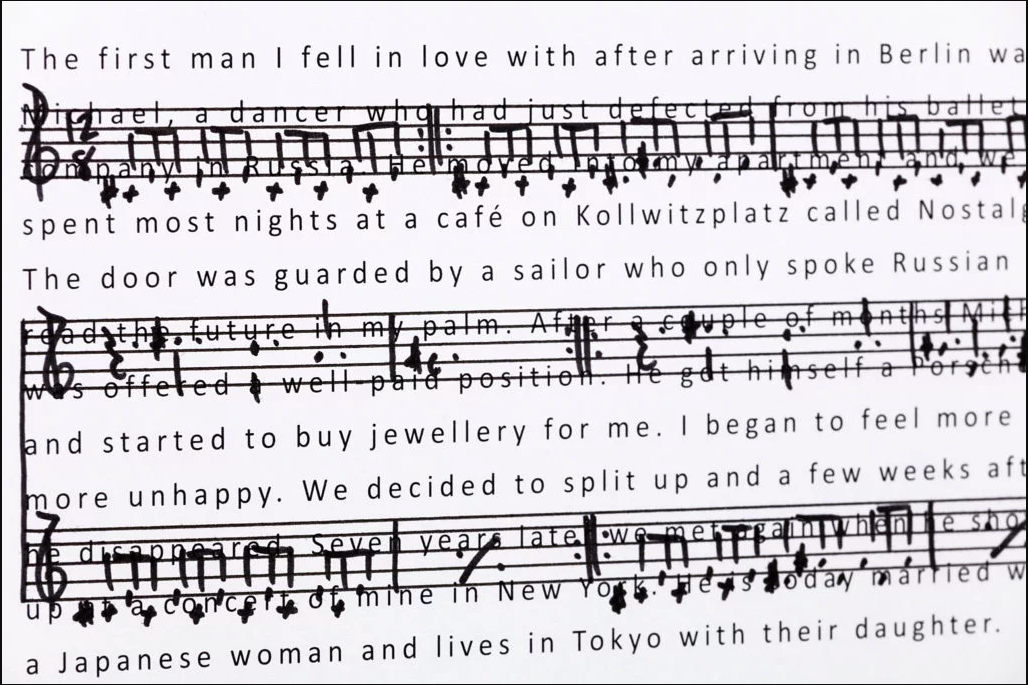
from Ari Benjamin Meyers: Solo for Ayumi
Indeed, music twines its listeners together by stirring otherwise-untapped emotions and memories. Both Swann and Pozdnyshev find musical language well-suited to describing their emotional flux; the latter admits in the milli-moment before forcing a dagger through his wife’s corset that “[he] might still have refrained and not done it, if she’d remained silent. But… these last words of hers…demanded a reply. And the reply had to correspond to the mood [he’d] brought upon myself, which was rising in a crescendo, and had to continue growing. Rage also has its own laws” (Tolstoy 65). A harrowing admission from a generally levelheaded storyteller, whose ears react to the breach of silence, directing the hands to murder accordingly. Lost in the momentum of his emotion, Pozdnyshev violently relinquishes control, not unlike the way some performers spew their fury onto the keyboard via crescendo and accelerando. The terrible notion that “rage has its own laws” echoes ominously throughout the remainder of the novella. Swann suffers similarly regarding Odette, although he never physically expresses his frustration: “‘Think of listening to Wagner for a whole fortnight with a woman who takes about as much interest in music as a tone-deaf newt—that would be fun!’ And his hatred, like his love, needing to manifest itself in action, the pleasure urging his evil imaginings further and further, because, thanks to the perfidies of which he accused Odette, he detested her still more, and would be able… to take the opportunity of punishing her, and of venting his mounting rage on her” (427). Swann envisions a release of rage comparable to Pozdnyshev's, collapsing all of Odette’s “perfidies” and general misbehaviors into a permanent personality flaw. While his handling of the “tone-deaf newt” echoes Pozdnyshev only in motivation, music heightens both characters’ suspicions that their loved ones have engaged in a string of “perfidies.” At the same musical gathering, other guests experience surges of sentimentality: “[When] the pianist [began] a prelude by Chopin, [one Madame turned to another] with a fond smile of knowing satisfaction and allusion to the past. She had learned in her girlhood to fondle and cherish those long sinuous phrases of Chopin, so free, so flexible, so tactile, which begin by reaching out and exploring far outside and away from the direction in which they started, far beyond the point which one might have expected their notes to reach, and which divert themselves in those byways of fantasy only to return more deliberately—with a more premeditated reprise, with more precision, as on a crystal bowl that reverberates to the point of making you cry out—to strike at your heart” (471). With this, Proust constructs the most incredible characterization of Chopin, surely as affecting in its structure and content as the aforementioned prelude itself. The first Madame, evidently the recipient of a fine music education, naturally falls into the proper state of “fondling” and “cherishing” the turns of melody, reveling in her non-nouveau riche-ness (as is her right to: familiarity with Chopin is a challenging and worthy undertaking). As the “long sinuous phrases” “[reach] out” with the elasticity characteristic of romantic music, the audience-members similarly slip between past and present.

same piano, not Woodleigh, 2015
Music also tethers people across time through both muscle and involuntary memory. Proust’s narrator notices that “[Madame des Laumes] had had lessons some fifteen years earlier from a piano-teacher of the Faubourg Saint-Germain, a woman of genius who towards the end of her life had been reduced to penury and had returned, at seventy, to instruct the daughters and granddaughters of her old pupils. This lady was now dead. But her method, her beautiful tone, came to life now and then beneath the fingers of her pupils, even of those who had become in other respects quite mediocre, had given up music, and hardly ever opened a piano. Thus Madame des Laumes could wave her head to and fro with complete conviction, with a just appreciation of the manner in which the pianist was rendering this prelude, since she knew it by heart” (Proust 473). This “just appreciation” by the Madame springs from a sensibility carefully cultivated in her youth. The piano-teacher mentioned inculcated the descendants of her old pupils with wisdom funneled through time by long-gone teachers; the traditions and techniques of classical music thus weave their way into modernity, from the physical touch of one teacher to another teacher-in-the-making. In an exercise of brain-muscle memory, the Vinteuil sonata catalyzes Swann’s return to a lost time, the early days of his courtship of Odette: “In place of the abstract expressions ‘the time when I was happy,’ ‘the time when I was loved,’ which he had often used… he now recovered everything that had fixed unalterably the specific, volatile essence of that lost happiness; he could see it all: the snowy, curled petals of the chrysanthemum which she had tossed after him into his carriage, which he had kept pressed to his lips the address ‘Maison Dorée’ embossed on the note-paper on which he had read ‘My hand trembles so as I write to you’… could feel the showers which fell so often that spring, the ice-cold homeward drive in his victoria, by moonlight; all the net-work of mental habits, of seasonal impressions, of sensory uniform meshes in which his body found itself inextricably caught” (Proust 491). Each image, delicately catalogued, progresses to the next in a way characteristic of Proust and his cinematographic principle: “a sequence of separately insignificant differences to produce the effect of motion or animation in objects seen. It vividly conveys the sensation of flux, of a steady linear change from one moment flowing into the next. Thus a series of stills in sequence can create the illusion of movement when riffled through rapidly under our eyes or thrown on a screen” (Shattuck 50). The reader, too, returns to these stepping-stones in the Swann-Odette story; somehow, the music recalls sudden remembrance of things past, reminding Swann to finalize a future. The potency of Swann’s memory permits him to momentarily bottle the volatile smoke of happiness that seems to leave most people the moment it arrives. Sadly, such a foray surely ends as soon as the music does.

Specifically, one’s reaction to music reveals aspects of his or her character and background. Proust catches these subtleties with particular humor. For instance, in the human metronome episode, one of the aforementioned madams—the recipient of a sound musical education—beats time with her head, inspiring her neighbor to wonder “whether these gesticulations might not, perhaps, be a necessary concomitant of the piece of music that was being played…whether to abstain from them might not be evidence of incomprehension as regard the music and of discourtesy towards the [metronome madam]; with the result that…at one moment she would confine herself to straightening her shoulder-straps or feeling in her golden hair for the little balls of coral or of pink enamel, frosted with tiny diamonds [while scrutinizing with cold curiosity her impassioned neighbor], and at the next would beat time for a few bars with her fan, but, so as not to forget her independence, against the rhythm” (Proust 467). This neat series of cause-and-effect unfolds algebraically (the oscillations of the metronomic madam and her neighbor’s fan alternate to account for all on- and off-beats), and assails the social stratification caused by such assemblies of inattentive audiences. Proust, after all, is the ultimate character-assassin. Next, he procures Swann’s contrastingly intellectual interaction with the music: “[the strain of waiting for the little phrase elicited] one of those sobs which a beautiful line of poetry or a sad piece of news will wring from us, not when we are alone, but when we impart them to friend in whom we see ourselves reflected like a third person whose probable emotion affects them too. It reappeared, but this time to remain poised in the air, and to sport there for a moment only…like an iridescent bubble that floats for a while unbroken. As a rainbow whose brightness is fading seems to subside, then soars again and, before it is extinguished, shines forth with greater splendor than it has ever shown, so to the two colors which the little phrase had hitherto allowed to appear it added others now, chords shot with every hue in the prism, and made them sing” (Proust 500-501). Swann “seeing himself” in the music is akin to the process of reading literature, a process that rather greedily claims portions of the story as one’s own life experience. The beautiful characterization of the Vinteuil’s “little phrase” that follows, enriched by optical language, inspires such awe that one cannot help but to admire Swann a little more for having noticed “chords shot with every hue in the prism.” Swann’s solitary engagement with the music thus seems less superficial than that of the two ladies, who perhaps listen with ulterior social motives.

musical memory no. 2—Woodleigh, 2013
Why and how, exactly, does music permit recovery of the past, tickling the Pavlovian pup in both Pozdnyshev and Swann? The former asks throughout his wife’s performance of Beethoven’s Kreutzer Sonata: “What is music? What does it do? And why does it do what it does… It seems to me that under the influence of music I feel something more than what I really feel, I understand more than I really understand, and I can do more than I can really do. I explain this by saying that music acts like yawning, I yawn; there’s nothing to laugh about, but when I hear someone laughing, I laugh” (Tolstoy 54). Here, Pozdnyshev gestures to the excess production of emotion and the heightened perception experienced by all listeners with their preferred auditory strains—the sort of perfect understanding that elevates the listener. The reference to involuntary yawning and laughing is particularly Pavlovian, as are the following mentions: “Consequently, music merely arouses; it doesn’t culminate. When they play a military march, the soldiers march and the music achieves its end; when they sing a mass, I take communion, and the music also achieves its end. Otherwise, it’s only provocation, and what follows as a result of that provocation is lacking” (Tolstoy 55). The slightly disturbing observation that music arouses without culminating refers once again to that excess of feeling produced by music-making and absorption. As in watching a film, one exits his or her present circumstances for a time, but only mentally; therefore, the conclusion of such reveries brings about only frustration and longing. Music that fulfils a distinct function, however, such as summoning from its listeners a physical action, is beneficially performed. Such ruminations are easily assailable: one could argue that the activation of imagination is in itself a form of repair. The unrelenting Pozdnyshev provides a sublime summary of his reasoning: “Excessive emotion that has no outlet… Is it really possible to play [The Kreutzer Sonata] in a drawing room in the presence of women wearing low-cut gowns? To play it and then applaud, to eat ice cream afterward, and gossip about the latest rumors? These pieces can be played only in certain important, significant circumstances, and then, only when certain important actions, corresponding to the music, are demanded… Otherwise the arousal of energy and emotion suited to neither the place nor the time, lacking an outlet, can’t help but produce a harmful effect” (Tolstoy 55). He has a fair point: music, trapped in its hermetic performance venues, reaches its target with increasing rarity. Applause sounds silly and digestifs turn sour following certain sounds.

same piano, not Woodleigh, 2017
Proust provides insight into the mechanical aspects of musical manipulation. After hearing Vinteuil’s “little phrase” performed for a second time, Swann “sought to disentangle from his confused impressions how it was that…it swept over and enveloped him, he had observed that it was to the closeness of the intervals between the five notes which composed it and to the constant repetition of two of them that was due that impression of a frigid and withdrawn sweetness; but in reality he knew that he was this conclusion not upon the phrase itself, but merely upon the certain equivalents, substituted (for his mind’s convenience)” (496). Here, Swann acts as a music theorist, tracing the “closeness of the intervals” and their “constant repetition,” attributing the “frigid and withdrawn sweetness” he experiences to these details. The “certain equivalents” he mentions refer to the system of symbols that comprise musical notation, which like words on a page contain no inherent meaning, but grant satisfaction through analysis. Swann continues theorizing, positing that “the field open to the musician is not a miserable stave of seven notes, but an immeasurable keyboard (still almost entirely separated by the thick darkness of its unexplored tracts, some few among the millions of keys of tenderness, of passion, of courage, of serenity, which compose it, each one differing from all the rest as one universe differs from another)” (Proust 498). Between the piano’s highest C and lowest A, there indeed lies infinite variety of pitch, interval, rhythm, dynamic, etc. (the vast canvas of space and time should assure any listener that he or she has not heard every possible combination). Oddly, some tonalities do correspond directly in composers’ minds to “[tenderness, passion, courage, and serenity];” apparently Vinteuil had been one of those musicians, and although his sonata “might present a clouded surface to the eye of reason, one sensed a content so solid, so consistent, so explicit, to which it gave so new, so original a force, that those who had once heard it preserved the memory of it on equal footing with the ideas of the intellect” (Proust 497). This is a bold claim: that the brain processes music as it does, say, natural language. Nevertheless, such sounds present “a clouded surface” to the inquisitive empiricist, resisting complete rationalization. Vinteuil’s “little phrase” existed in Swann’s mind “on the same footing as certain other notions without material equivalent, such as our notions of light, of sound, of perspective, of physical pleasure, the rich possessions wherewith our inner temple is diversified and adorned” (Proust 498). Sensations, not substances—such are the phenomena that, as Proust writes quite adorably, “[diversify and adorn]” our interior perceptions. That said, intensive exposure to music does not necessarily vary directly with the ability to produce it, though it does calibrate taste. Pleasures tend to be absorbed, enjoyed, and forgotten; thankfully, music performance ensures repeatability of pleasure. Proust concludes this extended passage by noticing that “so long as we are alive, we can no more bring ourselves to a state in which we shall not have known them than we can with regard to any material object…In that way Vinteuil’s phrase, [which represents to us also a certain emotional accretion], had espoused our mortal state, had endued a vesture of humanity that was peculiarly affecting” (Proust 498). So long as we live and hear, we remain subject to music’s wiles, susceptible to its clothing our bodies and coloring our thoughts. Representation of “emotional accretion” becomes our reality, as we cannot resist reacting physiologically to the stimulation of stereocilia.

Both Pozdnyshev and Swann marvel at both Beethoven’s genuine and Vinteuil’s fictional genius, respectively. During his wife’s performance, Pozdnychev remarks that “[music] immediately transports me to directly into the spiritual state of the composer. My soul merges with his and I’m simultaneously transported to another state” (Tolstoy 55); similarly, Swann expresses “a wave of pity and tenderness towards Vinteuil, towards that unknown, exalted brother who must also have suffered so greatly. What could his life have been? From the depths of what well of sorrow could he have drawn that god-like strength, that unlimited power of creation?” (Proust 495). It is natural to inquire after the source of a stroke of genius. Thus, to this day, music students submerge themselves in music history, constructing some context for their interpretations, lest they besmirch a composer’s intentions. In this way, moving performances do foster empathy, forging connections such as Swann’s “wave of pity and tenderness” across centuries. Beethoven’s riotous thundering, for example, remain as relevant to listeners today as when he first summoned such sounds. Thus, the composers of classics tapped—perhaps by divine appointment—into a well of universal value.

At the heart of each story, music is neither truly to blame nor to thank for that which transpires (marriage in Swann’s Way, murder in The Kreutzer Sonata): fate had ripened these characters to its influence. Pozdnyshev reflects that “from [his wife’s first meeting with the violinist] I saw that her eyes glowed in a special way…it seemed as if some electric current was immediately passed between them, evoking identical expressions, glances, and smiles. She blushed, and he blushed; she smiled, and he smiled” (Tolstoy 47). That Pozdnyshev took note of such mimicry and interactive “tightness”—so fundamental to musical teamwork—implies that he was looking for such signs to begin with, and also that his wife did not bother to conceal her emotions. That said, the flow of “electric current” remains out of mere mortal control. His wife’s emotional infidelity was the product of mounting discontent; Pozdnyshev surmises that “If the thing that happened had never happened, I’d have lived to a ripe old age [in perpetual fog], and I’d have thought, as I lay dying, that I’d lived a good life, not an especially good one, but not a bad one either, a life just like everyone else; I’d never have understood the abyss of unhappiness and the foul lie in which I was wallowing” (Tolstoy 39). True misery. Perhaps most miserable is the ambivalence that characterizes Pozdnyshev’s attitudes, one that feels hyper-realistic to the majority of those who lead “not an especially good, but not a bad” existence, numb to gratitude or indignation, for whom good and evil blend ambiguously. Recall that Pozdnyshev operates under rage’s own laws. While Tolstoy wrote with a moral agenda, Proust characterizes fluctuations in affection more mildly: “Physically, [Odette] was going through a bad phase; she was putting on weight… [Swann] would gaze at her searchingly, trying to recapture the charm which he had once seen in her, and no longer finding it. And yet the knowledge that within this new chrysalis it was still Odette who lurked, still the same fleeting, sly, elusive will, was enough to keep Swann seeking as passionately as ever to capture her” (Proust 414). Swann’s love for Odette was pre-existing; Vinteuil’s sonata only mediated, rather than directed, their conversation. His appreciation for the complex “chrysalis” of her character seems to survive changes in circumstance; thus, Swann and Odette receive a somewhat “happier” outcome than Mr. and Mrs. Pozdnyshev. Transferring culpability from the violinist to himself, Pozdnyshev emphasizes that “Everything occurred because of the terrible abyss that existed between us…in the face of which the first occasion was sufficient for precipitating the crisis…If he hadn’t appeared, it would’ve been someone else” (Tolstoy 44). Humans alone pluck the strings and strike the keys that influence their actions, trusting—or not—an omniscient conductor to spare them from the lawlessness of rage.

Works Cited
  • Proust, Marcel. Swann's Way. Translated by C. K. Scott Moncrieff and Terence Kilmartin, edited by D. J. Enright.
  • Shattuck, Roger. Proust's Binoculars: A Study of Memory, Time and Recognition in "A La Recherche Du Temps Perdu." 1963.
  • Tolstoy, Leo. The Kreutzer Sonata Variations: Lev Tolstoy's Novella and Counterstories by Sofiya Tolstoya and Lev Lvovich Tolstoy. Translated by Michael R. Katz, New Haven, Yale University, 2014.

Monday, February 12, 2018

Beijing (08-09/17) in two nutshells: Grandmother Song & 差不多的先生

1) Vienna Teng's Grandmother Song, w/ interjections:
https://open.spotify.com/track/2a0zgVcEQbt4pZCK5fhpHD

said auntie in shiny place
"Oh girl you think you got time / You're gonna get 'round to it way down the line / But one step, two step, you fall behind / So you better have a good plan

Oh girl you think you got time / You're gonna get 'round to it way down the line / But I'm telling you no matter what you have in mind / You're still gonna need a man

Take it from your grandmother [auntie] I've been 'round / No one's gonna take care of you / In that world you've got yourself into / All the good boys, oh baby they're in grad school [not Middlebury]

office space
Oh girl your story's all wrong / Your dream'll be a nightmare before too long / Turning thirty [22] and still trying to sing your songs [hah] / Come on who do you think you are / Oh girl it's too heavy a load / Your mama and your baba they are worried souls [troo] / How you gonna raise a family when you're on the road / With some tattooed boy with a guitar [Giant Peach]

Take it from your grandmother I've been 'round / This music career isn't real life / It won't see you through to when you're sixty-five [but maybe after that] / When the tide turns you won't survive / You'll sit on the banks and cry

meeting my middo best friend's mother :)
Oh girl you've never know war / When they come in the night and knock on the door / You can go from the high life to dirty poor [coffee shop wifi] / And lose everything you knew / But the one thing they can't take away from you / Is your mind and the education you've been through [yes!]
Because a woman isn't just for cooking meals [though here's how] / Scrubbing floors, making babies / A woman's got ambitions same as he does / Maybe more

middo visitor = island of sanity

When the sirens wailed and the bombs fell / We ran from the schoolyard into hell / And what we could've been time will never tell / 'cause we never had your chances / The advantages that you've been handed [SHS, Midd] / Take it from your grandmother [auntie] I've been 'round 

O you find a man who understands that too / Make sure that he stays true [hard] / Gives respect where its due / Make sure he knows what he's got in you [lest]"

2) 差不多的先生 ("Mr. Almost"), by MC Hot Dog (judgeth thee not): https://www.youtube.com/watch?v=mrqKvu-rqIc

from 798 Art Zone
我抽著差不多的煙 又過了差不多的一天 / 時間差不多的閒 我花著差不多的錢 / 口味要差不多的鹹 做人要差不多的賤 / 活在差不多的邊緣 又是差不多的一年 / 一個差不多的台北市 有差不多的馬子 / 差不多又幹了幾次 用著差不多的姿勢 / 看著差不多的電視 吃著差不多的狗屎 / 寫著差不多的字 又發著差不多的誓 / 差不多的夜生活 又喝著差不多的酒 / 聽著差不多的音樂 喝醉差不多的糗 / 有著差不多的絕望 做著差不多的夢 / 穿著差不多的衣服 腦袋差不多的空 / 差不多的掛 我說著差不多抱怨的話 / 時間也差不多了 該回我那差不多的家 / 差不多的瞎 指鹿為馬 都差不多嘛 / 繼續吧 繼續瞎子摸象吧 有差嗎

Hook: 我是差不多先生 我的差不多是天生 / 代表我很天真 也代表我是個賤人 / 這差不多的人生 這個問題艱深 / 差不多先生 我的差不多是天生 / 代表我很天真 也代表我是個賤人 / 這差不多的人生 總在見縫插針
3x per diem: le home foodlettes


差不多的反覆 總是差不多又義無反顧 / 差不多的感觸 總是差不多又愁雲慘霧 / 差不多的孤 差不多的獨 / 一條差不多的路 我吃著差不多的苦 / 我嗑著差不多的藥 又睡了一場差不多的覺  / 差不多的煩惱 差不多要把我逼瘋掉 / 差不多的 糟 差不多的 妙 / 差不多的 ㄋㄠ 又差不多的 屌 / 差不多的中國風 差不多要把耳朵蒙 / 歹戲拖棚 差不多要幫你送個鐘 / 差不多的歌手擺著差不多的烏龍 / 差不多的麥克風唱差不多的呼嚨 / 都在哭窮 差不多都像個豬頭 / 偏偏我和他們差不多是豬朋狗友 / 撒 差不多的謊 虎爛差不多的強 / 罵人差不多的嗆 不然你要怎麼樣

island of sanity pt. 2

798 heaven again
差不多的你 差不多的我 / 差不多的他 差不多的她 / 媽的差不多想發達 / 差不多打著哈哈 她罵著XX / 嘎嘎烏拉拉 都差不多的咖 / 差不多先生 他像個笑話 / 有人又在叫罵 / 差不多要跳不起來 還是要跳躍吧 / 差不多像烏龜 讓烏龜烏龜翹吧 / 這差不多的人生 他妙嗎 / 差不多要力爭上游 想游到上游 / 差不多在心裡默念阿們還有佛陀 不能放牛 / 差不多的生活很街頭 再差一點你就變成街友 / 我唱了八十八個差不多 都差不多 / 差不多 先生不會在乎這麼多 / 日子應該怎麼過 差不多的2008怎麼豁 / 我是差不多先生 熱狗

Saturday, May 6, 2017

albers einstein


Figure 1: Monument to Change as it Changes
Piano teachers know the antidote to insipid interpretation: call for a change of color. Monochromatic treatments of harmonic transitions have a flattening effect, while inflection lifts latent pitches from the page. This applies on canvas as well as in concert, according to Josef Albers’s Interaction of Color, wherein “the relationality of the former [interaction]” depends upon the “relativity of the latter [color].”¹ In addition to characterizing color’s interactive infinitude, Albers demonstrates that tone and color operate along axes of time and space, respectively. Peter Wegner’s Monument to Change as it Changes (Figure 1), however, eludes this essential distinction by fusing both variables into spacetime.

Throughout Interaction of Color, Albers employs myriad musical metaphors. One such example neatly establishes the essentiality of contextual consideration: “In musical composition, so long as we hear merely single tones, we do not hear music. Hearing music depends on the recognition of the in-between of the tones, of their placing and of their spacing.”² Likewise, isolated colors convey little visual information, however richly conceptual their presentation. Words, chemical elements, human beings—all such specimens seek to bond with others in pursuit of meaning. Albers continues the musical metaphor, elaborating upon “placing and spacing”: “The tune of ‘Good morning to you’ consists of 4 tones. It can be sung in a high soprano, a low basso, and in all in-between voices, as well as on many levels and in many keys… In all possible ways of performance, this melody will keep its character and be recognized instantly. Why? The intervals of the four tones, that is, their acoustical constellation (again comparable with a topographic relationship), remains the same. Although it is not common practice, one can also speak of intervals between colors. Colors and hues are defined, as are tones in music, by wavelength.”³ For example, complementary colors span the widest interval. Information lives in the distances between endpoints, rather than in the colors themselves. Such qualities enable the swift transposition of chords, as well as translation and transformation of graphs (thus the comparison with a topographical relationship). Despite such shifts, relationships remain intact, and retain the construction’s original “character.” Such a de-emphasis of the wavelength itself speaks to Albers’s focus on the interaction, rather than the physical properties, of color.


Figure 2: Homage to the Square: Lone Light
Following this distinction, Albers dismantles the ongoing comparison between tone and color, disclosing that “the metaphor misleads because basic conditions of these media result in different behavior.”⁴ First, Albers addresses music’s dependence on time: “Tones appear placed and directed in the time from before to now to later. Their juxtaposition in a musical composition is perceived within a prescribed sequence only. Vertically, so to say, one tone, or several simultaneously, sound for a varying but restricted length of time. Horizontally, the tones follow each other...only in one direction—forward. Tones heard earlier fade, and those farther back disappear, vanish. We do not hear them backward.”⁵ Music, then, depends entirely upon the progression of time; is an essential variable in its formulation. The unidirectionality of time’s arrow ensures music’s ephemerality, despite recording as a mechanical means of reproduction. In contrast, colors “appear connected predominantly in space. Therefore, as constellations they can be seen in any direction and at any speed. And as they remain, we can return to them repeatedly and in many ways.”⁴ The formula for color, then, rests upon variables xy, and z, all of which exist within the confines of three dimensions, and independently of the fourth: t. Constellations of color, then, arise from manipulations of space. Albers thus summarizes such thoughts: “This remaining and not remaining, or vanishing and not vanishing, shows only one essential difference between between the fields of tone and color.”⁴ Arrays of visual and aural possibility propagate endlessly, but orthogonally. Sound and light waves, crossing without constructing (or cancelling), interfere only in the imagination. According to Albers, the “field of color” does not vanish, despite time’s negligible efforts to fade, tarnish, or touch it. (Though to dust all return, art does so rather imperceptibly). Time, in fact, works to color’s advantage: while performers have a mere instant to produce the desired tone, visual artists may pause between brushstrokes, perfecting their product more peacefully. Space affects tone more significantly than time does color, as sound waves propagate through air and bump into objects, turning back the way they came for better (resonance) or for worse (audio feedback). Tones, therefore, are slaves to both time and space. Though endless, such “essential differences” between the interactions of color and of tones may be reduced to functions of x, y, z, and t.

When Peter Wegner constructed his Monument to Change as it Changes (Figure 1) in 2011, fields of tone and color had long collapsed and into a single coordinate system, as exemplified by video art. Having taken Albers’s “Color” course as an undergraduate, Wegner also appreciates visual relativity: “Because color is contextual, you can create a rich palette simply by varying the rhythm of a few different shades. Six sheets of this color followed by ten sheets of that. Different people would tell me a given paper installation had nineteen colors, or eleven or thirty, and in a sense, each was correct.”⁶ Varying numbers of colored sheets induces rhythm (though of a stop motion, illusory variety), considered by Wegner a critical component of color creation. In Monument to Change as it Changes, however, colored sheets are at the mercy of truly rhythmic flip-digit modules, the technology behind European train station arrival/departure boards. This time-dependent technique enables Wegner to “bend color the way Coltrane bends a note,”⁶ fusing both color and motion into perpetually-evolving contexts. 

The formal parallels between Albers’s and Wegner’s works enable further interaction between color and time. In an essay entitled “The Artist as Alchemist,” Nicholas Fox Weber observes that Albers “found multitude and stability in a few forms.” Albers’s nested squares, for instance, corralled color combinations both careening and calm (Figure 2). This particular Homage to the Square, evocative of egg, derives its architectural soundness from the perspective-preserving alignment of corners. According to Tate Modern curator Achim Borchardt-Hume, Albers likely selected squares for their abstract accessibility: “[Homage to the Square]’s primary concern was with the visceral nature of color perception. Yet, it is telling that the series’ title, rather than alluding to color, references the dominant shape; the word Homage suggesting Albers’s reverence for the square’s formal authority free from any representational associations.” Thus, the ubiquitous and therefore unfettered square best facilitates “visceral” detection of color interaction; representational forms would enforce a more limited reading of reality. Wegner favors the similarly-facilitative faculties of grids, which he calls “a distribution of cells. The distribution is universal. It’s how bodies and buildings and terrorists organize themselves. A painting or sculpture that borrows this form is just one more instance of the perpetual grid.”ٰ¹ Just as pixels codify information-dense imagery, squares and grids simplify chaos into constituent components. Grids, with their repeating rectangles, accomplish this in an especially meditative manner: in Albers’s early work Glitterbild (Figure 3), tinted glass nestles neatly into wire cells, while further cell-divisions evoke fractals. Wegner’s Monument to Change as it Changes also showcases the grid’s rationalizing rhythm, sectioning continuous colors just as measures mark music. 


Figure 3: Glitterbild
Grids create considerations of quantity. Albers muses that “although quantity and quality are considered disparate, in art and music they appear closely related. We may even hear, ‘Quantity is a quality,’ because here quantity not only designates amounts, as of weight or number, but also is a means of underlining, of pronouncement, and a means of equilibrium, of balance.”¹¹ For example, considerations of equilibrium may direct Albers’s placement of warm and cool colors throughout Glitterbild, while considerations of pronouncement determine his proportioning of Homage to the Square. The acts of placing and proportioning both require quantitative calculation and qualitative consideration. Wegner’s 3-ton, 2,048-flip module Monument certainly posed technical challenges in addition to its aesthetic puzzles. Albers continues: “The two basic quantity questions, how much and how often, distinguish two kinds of quantity: one of size (extension in area) and one of recurrence (extension in number). Both measurements… establish weight in space—and weight in time.”¹¹ Size obviously corresponds to “weight in space”: weight is a function of gravity, which increases proportionately with mass. By linking “recurrence” to “weight in time,” Albers suggests that repetition of two- or three-dimensional objects throughout space simulates the passage of time, possibly because one’s perception evolves as his or her eyes travel over a pattern. With 2,048 recurrences of the same form, Wegner’s Monument to Change as it Changes convincingly establishes weight in time; even in photographs, the colored cells possess the graduality of storyboards.

Figure 1 (detail)
In Interaction of Color, Albers refrains from characterizing color without context. If color is truly “the most relative medium in art,”¹³ how may one ascertain the attributes of a single shade? Synesthetically, perhaps. Critic Frederick Horowitz whimsically observes that “in Albers’s metaphorical world, free studies became orchestral sounds, cooking ingredients, flavors, geographical locations, actors in performances. Colors noticed other colors, dominated other colors, formed dictatorships and democracies… some [colors] were children who reflected the qualities of the parents,”¹ confirmed by the Homage[s] to the Square unambiguously titled Lone Light, Autumn Scent/Smell, and Advancing Spring. Note, however, that the aforementioned “[sounds, ingredients, flavors, locations, and actors]” remain particles eager to engage with others; the “dictatorships and democracies” depend upon constituents; and “children” inherit the traits of their parents—truly, colors resonate only in combination. Horowitz ascribes these comparisons to Albers’s familiarity with “Goethe’s ascription of character to colors in the Farbenlehre. Goethe, for example, saw ‘vivacity and nobility’ in yellow, ‘a strong feeling of warmth and joy’ in orange, and ‘a feeling of cold’ in blue.”¹ While most agree upon the orangeness of tangerines and other concrete objects, a color’s abstract associations vary. Thus, “Albers rarely talked about the character of color in the abstract. As a color could have one character in one place and a very different character in another, each ‘performance’ would necessarily stimulate different reactions in the observer.”¹ Both blood and certain berries absorb about the same amount of light; depending on context, the same hue elicits a spectrum of reactions. As Monument to Change as it Changes cycles through its eight hours of programmed choreography, changing context too quickly for conceptualization, the work preserves the purity of color in motion. Prismatic lenses, after all, demonstrate that all wavelengths sum to white light.

Throughout Interaction of Color, Albers “[looks] at the world with a scientist’s rigor to find… a language commensurate with his vision.”¹ Should this suggest physics envy, Albers insists that “just as the knowledge of acoustics does not make one musical—neither on the productive nor on the appreciative side—so no color system by itself can develop one’s sensitivity for color. This is parallel to the recognition that no theory of composition by itself leads to the production of music, or of art.”¹ Why, then, did Albers bother to transcribe color’s conversations, then prescribe them to his art students? In “grasping the action and interaction of color as registered in our minds,” he answers, “we practice first and mainly a study of ourselves. Thus, we replace… retrospection [art historical and theoretical studies] with introspection… This proclaims creative action ahead of retrospective reaction."¹ While such a statement seems to supplant art historical inquiry with the psychological (not physical, as originally suspected) variety, this is not the case. Rather, Albers articulates an additional mystery to be solved before (for the previously untrained), alongside, or after historicization: the artistic history of oneself, arising from momently interactions with color. Indeed, Weber wrote that “[Albers] wanted [his] art to be immediate and inclusive, intelligible without any art-historical knowledge or academic education. Above all, [he] wanted it to be of its time.”¹⁹ Albers’s monumental text on color features in the etymology of Wegner’s Monument to Change as it Changes, which—for its relative contemporaneity—commemorates the complexity of our time. Throughout the time I spent studying economics in the building opposite Monument to Change as it Changes, I saw fluctuating market data in its cells, while other observers fathomed its hypnotic harmonies according to their own experience—such is the beauty of abstraction, more real to Albers than nature. The monument composed of color spins through spacetime, changing {you} with every interaction.

Figure 1. Peter Wegner, Monument to Change as it Changes
2,084 flip digit modules, each with 80 colors screen printed onto polycarbonate, steel, software, 108 × 384 × 3 in., 8 hrs of programming, 2011. (Consulting architect: Matt Flynn) Permanently installed at Stanford University.

Figure 2. Josef Albers, Homage to the Square: Lone Light, 1962
oil on masonite; 18 × 18 in. (45.7 × 45.7 cm)
Figure 3. Josef Albers, Gitterbild (Grid Mounted), ca. 1921
glass, metal, and wire; 123⁄4 × 113⁄8 in. (32.4 × 28.9 cm)
¹Nicholas Fox Weber, the artist as alchemist to Josef Albers: A Retrospective, comp. Solomon R. Guggenheim Museum, New York (New York: Harry N. Abrams, Inc., Publishers, 1988), 99.
²Josef Albers, Interaction of Color: New Complete Edition (New Haven, CT: Yale University Press, 1963), 5.
³Albers, Interaction of Color, 32.
⁴Albers, Interaction of Color, 37.
⁵Albers, Interaction of Color, 37.
⁶Peter Wegner, "10 Questions for Peter Wegner," interview by Cynthia Houng, KQED Arts.
⁷Nicholas Fox Weber, the artist as alchemist to Josef Albers: A Retrospective, comp. Solomon R. Guggenheim Museum, New York (New York: Harry N. Abrams, Inc., Publishers, 1988), 40.
ٰ¹⁰Peter Wegner, P,E,T,E,R,W,E,G,N,E,R, (n.p.: Griffin Editions, 2007).
¹¹Albers, Interaction of Color, 40-41.
¹³Albers, Interaction of Color, 1.
¹⁴Frederick A. Horowitz and Brenda Danilowitz, Josef Albers: To Open Eyes (n.p.: Phaidon, 2009), 32.
¹⁵Horowitz and Danilowitz, Josef Albers, 32.
¹⁶Albers, Interaction of Color, 2.
¹⁷Albers, Interaction of Color, 47-49.
¹⁸Weber, the artist as alchemist, 74.
¹⁹Achim Borchardt-Hume, ed., Albers and Moholy-Nagy: From the Bauhaus to the New World (New Haven, CT: Yale University Press, 2006), 78.