 |
| listen to Largo from Bach's Violin Sonata No. 3 https://www.youtube.com/watch?v=iARBh_DfP0w |
Tuesday, July 8, 2014
one thing remains: tying knots, ending eras

Friday, June 20, 2014
our moving castle, part 3
 |
| Meet Will Smith! |
For one week only, of course. He was grayer than the rest, so we named him Will Smith (clarification: I named him Fresh Prince, but S insisted on the former). Despite the pee and poo, I loved our little friend who lived in the blue kitchen corner.
 |
| lakeside plum blossoms |
 |
| Will Smith is a cage-free chicken! |
But the tippy-toppest part of the day--perhaps of the trip--was a 2000+ step hike (I counted) (all the hiking trails I've been to in China are steep stone stairways). Number of hikers inversely proportionate to altitude. Eventually, it was just S and me, two walls of bamboo, gnatty pools, crisp air. Light green, stone gray. Climbed on and on.
 |
| one foot over the other |
Dinner in a violently velvet banquet hall. Noteworthy nosh: 酒釀湯圓 (sweet rice wine and egg drop soup), durian pastries, logs of sesame rolls. Conversation fueled by vodka; A-GAN was prime tease target (baldness, Lasic eyes, HAR HAR). Ariel demonstrated Hangzhou dialect--I conclude that car sounds like hammer. Nice new friend: distant cousin, 15, scholar of soccer, beautiful penmanship, watched Forrest Gump before. A hand-shake goodbye. And at last, the cherry: a foot massage nearby, er, salon. Boy oh boy, I could not stop giggling: my lower limbs never been so limber-ized. S got a back massage that worsened his condition, hoho jolly jolly. Long (hour-long) story short*, our feet became baby butts. I collapsed like a jelly on the bunk-bed. To top off the day: a toothbrush dance with Samuel! *Foot potions: essential oil, milk, and ginger flowers. Scalding. Drinks: chamomile tea. TV: game shows, pseudoscientific infomercials. Masseuses: ripped.
 |
| West Lake at dusk |
Nighttime! Ariel and I puttered to "InTime" shopping mall's food court for dinner. 'Twas a eater's heaven, with foodstuffs galore! First a stop into Watson's, the lovely turquoise pharmacy; marveled at imitation Baby Lips. Tonkatsu for Ariel, tomato eggs for me. Jealous of neighbor's fish and pickle clay pot. Cold Stone mud pie, which I demolished when Ariel was using the restroom (so, so sorry... Nothing, not even the bond of Tong Xue, survives my stomach's stirrings). At home, S was speaking to a new friend (same age, gap year; his father had passed away) that looked like Po, and entered high school for drawing. Accompanied S to "InTime" again, this time for his dinner. Japanese restaurant had never-ending tea on tap. Smoky arcade: spend 6 coins on Speed Racer. S is deft driver of fake cars.

.jpg)
Saturday, June 14, 2014
Molto confusioso... Poco a poco de-obfusco... Lumos!
A lot.
A tater tot.
A turkey trot.
This post's begun to rot...
It's hard to move when it's so hot.
Anyway... There's an appropriate segue into the program* notes I wrote for my graduation recital, in case anyone cares for a foreign set of impressions.
From Julius Caesar: "But men may construe things after their fashion/clean from the purposes of the things themselves."
Toccata from Partita no. 6 / J. S. Bach
In his first few years as music director in Leipzig, Bach was tasked with writing four four-hour-long worship services’ worth of music, a program for every church. Six partitas (“entertainment pieces,” as Bach called them) resulted. Partita No. 6 is somewhat of a black sheep among the others, in my tentative opinion. Darker in color, introspective, and venerable, it rolls along with graceful viscosity (like maple syrup). The Toccata, an unusual opening to a partita, consists of a fugue bookended by two cadenza-like “frames.” In the arpeggiated chords, listen for the strumming of a flamenco guitar, and later on, the delicate pouring of oil. The fugue travels a desperate spectrum, sometimes peaking hopefully but temporarily before tumbling back into frustration. The final cadence, though, declares victory.
Sonata in Eb Major / Haydn
Papa Haydn is quite the jester. This particular sonata exemplifies cheeriness: the first section is lively, the second is sedated, and the third is as cute and coquettish as can be. Brief bouts of Beethoven-like mystery punctate every movement. Truthfully, I spent most of this past year in mellowish humor, and it was difficult for me to muster my usual giddiness for this piece. Yet a little bit of joy always manages to bubble to the surface.
Passacaglia / Handel-Halvorsen
Spanish: pasar = walk, calle = street. Short variations dancing on a solid ground bass. Johan Halvorsen, a Norwegian composer, took a harmonic seed from Handel’s Keyboard Suite No. 7 in G minor. More than a century later, Passacaglia for violin and viola bloomed.
For as long as I have known of this piece, I have longed to play it. Never did I imagine that my dad would one day play it with me, acting as a steady ground bass in music as he has been in my life.
Etude in f minor / Chopin
This little etude has been nicknamed by non-Chopins as “the ribbon.” Very fitting, as the right hand plays a continuous stream of sextuplets, while the left hand waves a ribbon of triplets. Like a pearl necklace, each note has its place (when I was little, though, my piano teacher told me that every piece I played was like a smile with several teeth knocked out--always imperfect. Hope that this performance presents a neater set of pearly whites).
Two Nocturnes
Chopin used to compose his nocturnes in sets of three, but Op. 27 marks his transition to contrasting pairs. These two nocturnes, in tense c# and dreamy Db, are enharmonic. From the same pitches, Chopin spins entirely contrasting stories. Both are sandwiches of sorts: the first is sad-happy-sad-serene, and the second is happy-sad-happy-serene (sad and happy corresponding to minor and major, respectively, not the exact atmosphere).
What I love most: when, with the change of a single pitch, minor turns to major, or major to minor, or some sound to another. Nocturne Op. 27 No. 1 brims with these turns, but makes us wait for them. In a desert of c# minor, E major refreshes the ear for a few brief measures.This nocturne is marked by musical gravity; whenever the melody ascends, the notes face resistance; when it descends, they fall simply, like feathers in a vacuum. Just like climbing.
Misha Galant linked his performance of Nocturne Op. 48 No. 1 to Hans Christian Andersen’s short story “The Little Match-Seller.” The image stuck with me, and I found that it fit this nocturne as well: a little girl lights her own wares to keep warm on winter’s night. Visions of her grandmother -- the only one who ever loved her -- and Christmas trees illumine the night. To sustain them, the little match-seller strikes every match, and they swell into a great golden conflagration. She freezes to death when the matches run out. Her soul is carried to heaven by her grandmother, away from ice and an empty belly. Grandmother pours light for the little match-seller, and the windows await her arrival.
Nocturne Op. 27 no. 2 is in Db Major, a key that in my head corresponds to the murky blue of the sky. The melody floats along without settling cadence-wise until the last page of the piece. The crabs in this picture scuttled over from Alfred J. Prufrock’s love song, but Nocturne belongs to another poem. We studied Shakespeare’s Sonnet CXVI at school, and I found that its tone, color, and meaning fit the Nocturne precisely. In the sonnet, love is called “the star to every wand’ring bark,” steadily bright even with the passage of time. In Nocturne, the left-hand accompaniment is the deep water, and the right-hand melody is the boat, which stretches toward a star every few measures. The illustration seeks to unite two poems -- one musical, the other literary -- into a constellation. Here’s the full sonnet for your enjoyment:
Let me not to the marriage of true minds
Admit impediments. Love is not love
Which alters when it alteration finds,
Or bends with the remover to remove:
O no! It is an ever-fixèd mark
That looks on tempests and is never shaken;
It is the star to every wandering bark,
Whose worth's unknown, although his height be taken.
Love's not Time's fool, though rosy lips and cheeks
Within his bending sickle's compass come:
Love alters not with his brief hours and weeks,
But bears it out even to the edge of doom.
If this be error and upon me proved,
I never writ, nor no man ever loved.
Waltz No. 3
My dear friend Vivian Wang premiered Robert Livingston Aldridge’s Three Waltzes just two years ago. That summer, she did all her practicing at my house, and I would bop about upstairs to the infectious rhythms of Waltz No. 3. Aldridge very innovatively employs constant hemiola, but in doing so makes this waltz utterly undanceable, unless you dance like Julianne Wey and me (like two ducks bouncing buoyantly on webbed feet). My image for this piece eventually evolved from two ducks to--very highbrowly--The Little Mermaid. First, Sebastian sets the tone on bongo-like seashells, while other fish swim in frenzied circles. There is a trance-like section in the middle, during which I assume Ariel undergoes her transformation from mermaid to land-dweller. At the recapitulation of the main theme, Ariel takes a few measures to regain her footing, then proceeds to party as she did in the sea.
Thursday, June 5, 2014
Play It to Beat It: An Ethical Analysis of Independent College Counseling

Note: To make sense of the whirlwind that is college admissions, I wrote an ethical research paper on an issue that I've been pondering all year: independent college counseling. I was a staunch opponent of the practice until I began to really research the topic. In this essay, I neither heartily support nor condemn independent counseling; instead I seek to qualify several points of view, bring to light the dilemma faced by my peers and their parents, and apply several philosophies studied in AP Lang to a relevant issue. While this paper may seem at times to be full of factoids (generalizations about Yale's admissions process, Katherine Cohen's characterizations of competition), I sifted carefully through studies conducted by credible counseling organizations for information that they deemed to be truth.
A New Need for Counseling
In decades past, the college applications process was a simpler animal. But as the population balloons, so does competition. Saul Lelchuk, director of HS2 Academy’s Northern California branch, emphasizes that “the admissions landscape has changed, drastically and dramatically. To feel nostalgia for an earlier, simpler time is fine, provided one is willing to acknowledge that that era is behind us, for good and for bad.” Acknowledging a new era means equipping oneself for the impending task, using all available resources, including independent counseling services. Confounded with increased competition are factors such as affirmative action and legacy: having a parent attend Stanford is equivalent to a 45.1-point bump on the SAT (Lee). Yale judges three-quarters of its applicants qualified for admission, and relies on the litmus tests of legacy and affirmative action to separate the 8% percent from the rejected. These twists ensure that students have no power in controlling college outcomes, despite their qualifications.
What to do, then, if admissions officers follow no formulas? Applicants with advisors squash soloists with ease. At HS2 Academy, counselors begin grooming applicants as early as their eighth grade year, for “from the moment a student enters high school, everything they do—or fail to do—affects their likelihood of making it into a good college,” writes HS2’s founder, Ann Lee. Counselors arrange four years’ worth of course loads, summer schedules, and extra-curricular activities, all catered to the student’s unique background, goals, and propensities (Lee). The modern college application process no longer consists of simply filling out forms before deadlines; counselors seek to cultivate persons that completely close the gap between potential and performance, and to eliminate as many variables as possible in the success equation.
Katherine Cohen, empress of Manhattan college counselors, summarizes the current climate of college admissions by remarking that "[applicants] can't just wing an application and get in; [they] might have been able to do that twenty years ago if [they] had the grades and the scores.” Getting a student into a school that he would have been overqualified to attend twenty years ago is, in her words, “a feat roughly equivalent to resurrecting the dead.” Generation X is convinced that they would not have been accepted by their alma maters as applicants today (Finkel). Because the line that separates admits from rejects is “necessarily arbitrary,” only independent college counselors, most of them ex-admissions officers, are fit to maneuver the dizzying marketplace that is the college admissions process.
Not All Counselors Are Created Equal
Both private and public schools offer college counselors that have the power to vie via phone call for their students, while independent counselors are denied college contact. However, independent counselors are preferable to both, for reasons specific to each.
Public-school counselors, drowning in seas of 300-1000 students each, are simply too overwhelmed to be of much aid to an applicant. Thus, phoning colleges is a privilege wasted on inundated school counselors. With this in mind, Lelchuk finds the contempt for independent counselors illogical: “[public-school counselors] can be trusted to fill out a recommendation for a student (even if they have only met that student for the requisite ½ hour or hour throughout four years of high school) while we [independent counselors] should not be allowed within ten miles of an application even if we’ve been meeting with the student multiple times a month for the last six months or year.” Truly, independent counselors paint more honest portraits of their client, yet their interference -- if discovered by admissions officers -- renders applications suspicious.
On the other hand, private-school counselors charge exorbitant tuition for the same quality of services offered by independent counselors. Lelchuk notes that his “counterparts at the best private schools can, and do, pick up the phone – except the catch is that to attend these selective institutions you can often count on paying upwards of $30,000 per year to do so.” Harker Academy Upper School, which charges $40,500 per term, sends significantly more students to elite schools than the local public schools do (Lee). The distinction does not lie in their quality of academics, but rather in their low student-to-counselor ratio. HS2, C2, and Flex Academies, which serve the South Bay, offer comparable services for an average of $2500 per year (HS2). The astronomical price of a private-school education confirms that students do “buy their way into a meritocracy,” as told by Katherine Cohen. While independent services are also costly, they are far worthier investments for communities that can afford them.
With potholes marking both public and private pathways, independent counseling is the applicant’s “golden mean,” Aristotle’s middling of two extremes (Aristotle). Lelchuk confirms: “as for private counselors, we’re caught between the two.” Third-party counselors save students both their tuition and their chances. The regret described by Columbia University student Carla Buccino plagues private-schoolers: “We like to think we’re all here because we earned it. But many of us are here because we could pay the price of admission.” Public-schooled students who endured applications alone oft wonder what could have been had they counseled independently. The most moderate solution lies in those sterile, testimony-plastered office buildings along De Anza Boulevard.
All for One, Not One for All
Independent counseling, as a service industry, ought to have the best interests of its clients in mind. But as with all businesses, profit is the primary goal; a happy college outcome is a pleasant side effect. This exchange is most successful under a few conditions laid out by Eli Finkel and Grainne M. Fitzsimons in The New York Times: “When the recipient clearly needs it, when help complements rather than replaces the recipient’s own efforts, and when it makes recipients feel that we’re comfortable having them depend on us.” If the act of counseling fulfils these requirements, then the transaction is considered fair.
But profit, as an incentive, is an impurity. It prevents hired counselors from exercising goodness without qualification (Kant), and taints their good-will, which in fact extends beyond success-security into what Lelchuk calls “the eternal Sisyphusian struggle of convincing families to look past the rankings, past the glossy brochures, at which colleges are actually right for their children.” Counselors intend to influence not only admissions decisions for the better, but also worldviews. Still, this good-will is disqualified by monetary compensation.
Also, college counseling does not satisfy Kant’s categorical imperative, because its effectiveness hinges on its exclusivity (Kant). If the practice were adopted by all, then private counselors would be as available as their public-school equivalents. With every student is marketed to perfection by a counselor, admissions officers would not be able to identify the best buy (Gardner).
Aligned with Kantian ethics, however, is a dedication to the integrity of the “means,” no matter the “ends.” In The Foundation for the Metaphysics of Morals, Kant writes that “the good will is not good because of what it effects or accomplishes.” Counselors are as powerless as their clients at effecting certain results. Lelchuk admits: “Sometimes I’m successful in these efforts; many times I am not.” Despite the odds, counselors proceed with the gamble that is college admissions, aware of potential lawsuits filed by dismayed parents come springtime.
Not All Counselors Are Created Equal II
To dispel rumors of deceit, the Independent Educational Consultants Association released a set of ethical guidelines: “A member’s primary obligation is to assess, make recommendations for, and represent each student accurately and fairly based upon a professional evaluation of the circumstances.” Interpretations of this code vary by counselor, depending on their geographic location (Jaschik).
Critics are most skeptical of essay-editing services. IvyWise, a high end counseling service in Manhattan, affirms that “while we do not write essays for students, we do make detailed suggestions for content, structure, style, tone, vocabulary and spelling. We review, comment and correct subsequent revisions until the student and counselor agree the essays are in optimal shape for submission." Most would agree that aforementioned process would result in a voice not entirely belonging to the applicant; indeed, IvyWise essays are the children of combined minds.
Across the country, HS2 displays fewer tendencies to hoodwink. Their tactics aim to calibrate an essay to a single authoritative taste. Ann Lee, founder of HS2, finds that first drafts “careen like pinballs, sent one way by the casual comment of a teacher, another way by the stern direction of a friend’s older sister who goes to college somewhere and is therefore an unmitigated expert on all things collegiate.” Students wavering between conflicting criticisms would benefit from a single, solid assessment by a knowledgeable counselor. Such an approach leaves fewer opportunities for artificiating personal statements.
By-Products Justify Practice
The fruits of independent counseling are not at all limited to admission. In every essay-editing session, counselors see opportunities to apply the old maxim of teaching a man how to fish, instead of giving him one to eat (Lelchuk). Instead of penning essays for their clients, counselors teach the art of writing. Mastering clear communication, especially on a subject as elusive as the self, will serve students at every stage.
Also, counselors open avenues for the development of latent talent. Virtues, after all, are honed through learning and practice (Andre), two tools passed from counselor to client. Yes, a neuroscience internship handsomely accessorizes an application, but also contains immaterial worth. Counselors mine for these experiences: “I guided [a client] into an opportunity that she wanted but might not have known was out there. So, no, I don’t think that I obscure character. I like to think, rather, that I help display what already exists in a nascent stage,” writes Lelchuk. To focus a college education, counselors advocate early exposure to programs that correspond to one’s passions.
Cumulative Leaps
In an interview, Katherine Cohen noted tersely that “it’s never going to be a level playing field.” Growth and interaction of populations shift peaks of prosperity and redistribute equality constantly. To cope, virtue ethicists draw “certain ideals, such as excellence or dedication to the common good, toward which we should strive and which allow the full development of our humanity.” Ethical college counselors act in accordance with this framework. Also, in weighing the net positives and negatives of the practice (Mill), one concludes that college counseling increases accessibility to education more than it does eliminate opportunities for others, and therefore receives the utilitarian stamp of approval.
Ultimately, colleges admit those whose applications confirm their “pre-destination.” Lelchuk writes that “the gratification lies not in getting an undeserving slacker in... it stems from seeing the system of higher education working the way it was designed to work, accepting students who will – given the right resources, instruction, and environment – prove a credit to their college both on campus and beyond.” College counseling propels driven students to positions from which they are poised to optimize humanity’s well-being.
An admission is legitimized by the actions that follow it. What a student makes of their undergraduate admission, and every admission that follows--to graduate school, a company, a relationship--is what truly matters.
Works Cited:
https://docs.google.com/document/d/1EZXmpb4_KWzEnIiOWaKu4MVheQ7QWbYKi1Y7a0doZ30/edit
In an interview, Katherine Cohen noted tersely that “it’s never going to be a level playing field.” Growth and interaction of populations shift peaks of prosperity and redistribute equality constantly. To cope, virtue ethicists draw “certain ideals, such as excellence or dedication to the common good, toward which we should strive and which allow the full development of our humanity.” Ethical college counselors act in accordance with this framework. Also, in weighing the net positives and negatives of the practice (Mill), one concludes that college counseling increases accessibility to education more than it does eliminate opportunities for others, and therefore receives the utilitarian stamp of approval.
Ultimately, colleges admit those whose applications confirm their “pre-destination.” Lelchuk writes that “the gratification lies not in getting an undeserving slacker in... it stems from seeing the system of higher education working the way it was designed to work, accepting students who will – given the right resources, instruction, and environment – prove a credit to their college both on campus and beyond.” College counseling propels driven students to positions from which they are poised to optimize humanity’s well-being.
An admission is legitimized by the actions that follow it. What a student makes of their undergraduate admission, and every admission that follows--to graduate school, a company, a relationship--is what truly matters.
Works Cited:
https://docs.google.com/document/d/1EZXmpb4_KWzEnIiOWaKu4MVheQ7QWbYKi1Y7a0doZ30/edit
Friday, May 30, 2014
The Battle of Lexington and Concord Grape Jam: The Revoculinary War
Making up for many empty weeks! Here's a (ridiculous) paper that I wrote this year. Thank ye, high school, for squeezing the strangest sentences out of me.
 The Anglo-American feud persists to this day. It lives on in traffic laws, economic schools of thought, and literary loyalties (to Rowling or Collins). “It’s the rebellion, darling,” hums my English neighbor, whenever she encounters a misspelling of “grey” or a mispronunciation of “garage.” The English display maturity in all matters of culture, and flaunt it in tabloids and television. Seeking the secret to their stiff-lipped soul, I sampled from the bouquet of British offerings the scrumptious BBC Food Channel. Extensive research affirmed that TV-chef allegiances ought to lie across the Atlantic, where culinary programming of an artistic quality seeps into lucky living rooms.
When one flicks on the telly, they expect an escape. Why, fellow Amuricans, remain steeped in our all-too-predictable, unspiced culture? Why settle for the predictable scenery of Malibu and suburban Connecticut when there waits swaths of Essex countryside piped with hares and hobbits, or Dickens-esque sunset profiles of the London skyline; for the limited inflection of American accent, when there waits the Scottish lilt and Cockney cackle? Those of us who are couch-chained revel in one-hour invitations into foreign kitchens. Thus, a transfer to Team UK, purely for scenic purposes, is in order. There’s no competition regarding overall quality of cinematography; while American producers dwell on details of hair and makeup, British shows devote those energies toward manicuring sets: no gleaming copper pot nor solitary chopstick is out of place. Those enveloped by the world of Harry Potter, Game of Thrones, Chronicles of Narnia, Spice Girls, Bridget Jones, and other Anglophilic indulgences would only benefit immensely from a tasteful trip across the pond; ‘tis a continuation of fictional forays. At last, they may solve for themselves the mysteries of pasty vs. pastry, and learn to assemble Harry’s favorite treacle tart.
In addition to extensive culinary training, the average British food star possesses an impressive record of academic achievement. The flamboyant Nigella Lawson has an undergraduate degree in Medieval and Modern languages from Oxford University, as shown in every show. While most TV chefs inject childhood anecdotes about watching their Nanas assemble pierogis, Nigella folds an Middle English history lesson into every episode, just as she folds egg whites for meringues. The viewer simultaneously improves in two aspects of culture, both crucial for survival and thrive-al. While tales of Giada’s Aruban vacay and Ree Drummond’s soccer potluck are at times enlightening, the true Epicurean derives pleasure from all sources, especially the font of knowledge. Drink up, I say -- a simple conversion of cook-loyalties admits thee to a higher class of culinary intelligentsia.
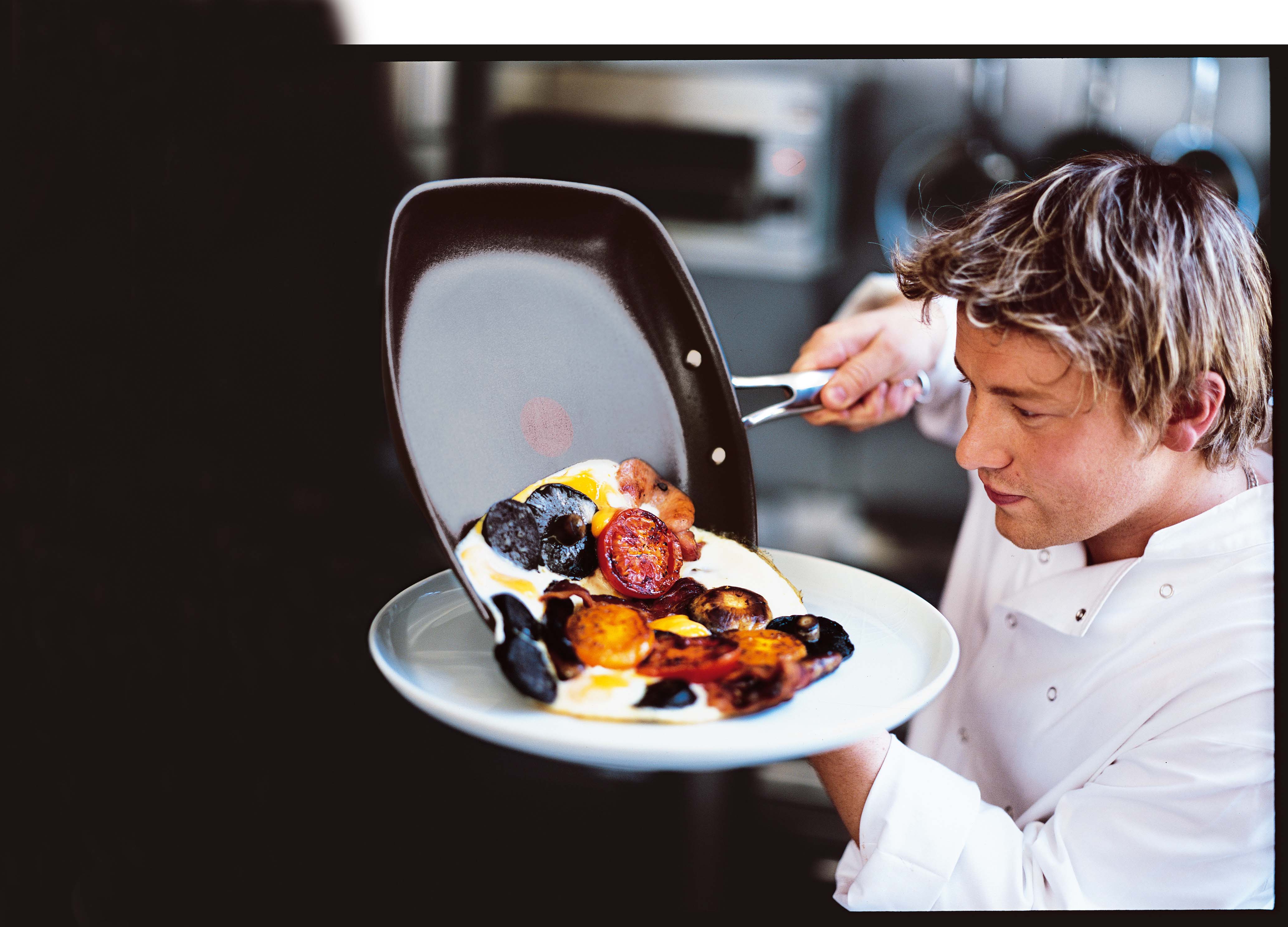
Aesthetically, BBC chefs take the cakes. Nigella Lawson, the “Domestic Goddess,” is famed for her glossy chestnut ringlets, pearlescent porcelain complexion, eyes the size of vacuoles, and a voluptuous figure to shame all voluptuous figures (which she dresses accordingly). At his prime in the mid-nineties, Jamie Oliver achieved heartthrob status; herds of teenage girls tuned in weekly to “The Naked Chef,” misled by the title. Jamie, at the tender age of nineteen, resembled a golden retriever, with his scruffy yellow bangs and large pink lips, clad in flannels and an apron. His motorbike, which he dismounts at the beginning of every episode, creats a fascinating contradiction between country lad and bad fellow. Gordon Ramsay is the Lion King of chefs: his tousled sun-kissed ‘do, burnished peel, and Scottish-ringlord stature elevate him to Adonis-hood. Flubber is more fairly distributed among the British chefs, while Ina Garten and Paula Deen, friendly pear-matrons of Food Network, are over-blessed with it. However, judges of the aesthetic contest must consider Malibu-based TV chef Giada de Laurentiis, daughter ofItalian film stars, whose looks put most A-listers to shame. Still, the British crew of culinary communicators has greater net attractiveness. These chefs’ marriages verify their pulchritude: Jamie Oliver married a supermodel called Jools (retainer of a svelte silhouette, even after fourteen years of taste-testing), and promptly produced four children (with organic names like Buddy Bear and Daisy Boo Pamela). Nigella Lawson pocketed London’s foremost art collector, Charles Saatchi. Attention to appearances extends to cookbookery: the collected works of Jamie Oliver and Gordon Ramsay surpass those of Rachael Ray and Wolfgang Puck in font selection and margin width.
As usual, our friends across the pond display deeper mastery of the English language. American audiences must settle for contractions and vagaries, while British chefs treat their viewers to slews of literary devices. TV, oft-scorned as an intelligence-sapping pastime, regains its credibility under their stewardship. In each of her episodes, Nigella Lawson employs many a magnificent metaphor (she refers to al dente linguini as “golden tresses,” evoking images of Rapunzel and Debussy’s Girl with the Flaxen Hair), encouraging her disciples to compose poetry as they wait for butter to brown. Gordon Ramsay subscribes to the proverb “Give a man a fish, feed him for a day. Teach a man to fish, feed him for a lifetime.” His instruction is laced with pieces of technical advice that transcend recipes; that seek to make thinkers from automatons. Jamie Oliver’s famed monologues are equally substantial: each food lesson carries a lesson on living with it, as easily as butter carries alliums. While certain American chefs (Alton Brown, mainly) may be praised for their concision and wit, most of them flounder and ramble, baby the watcher, and run out of synonyms for “Delicious!”. Sandra Lee, hostess of Food Network’s Semi-Homemade, suffered a bout of aphasia when she described a crumbly cupcake as “juicy” -- one (amusing) verbal misdemeanor among many. In stark contrast, the British Cooking Crew, armed with assurance of the ages, stirs up food for thought in addition to digestion.
Like European concert pianists, British TV chefs have mastered a wider repertoire than their American counterparts. The culinary forays of Bobby Flay are confined to Texan barbeque, and Giada de Laurentiis seldom ventures beyond Italian-Californian fare in shades of bisque and green tea. When American chefs carry their enterprises abroad, they are met with disinterest: celebrity chef Guy Fieri’s American Restaurant and Bar received scathing reviews from Parisian critics, a suggestion that the American culinary canon is ill-suited to international audiences. True, British chefs rely on centuries of European culinary tradition to back their expeditions, but none take their gastronomic heritage for granted. Jamie Oliver, at his young age, has opened fifteen restaurants internationally that feature Pho, foie gras, and everything in between. Instead of dulling their taste buds on various permutations of hamburger, viewers of British food television sharpen their worldliness.
The two schools of cheffing differ most, however, in their aim. American cooking shows maximize convenience, speed, ease, and satisfaction-factor; land and resource-challenged British chefs are keen on nutrition-dense diets and the local-food movements. The Food Network recipe index is bogged down by excess salt, vegetable oil, cornstarch, and red meat, perennial staples of the American diet. Jamie Oliver et al firmly espouse nutrition-centric choices and have carried their campaigns to America, where the obesity, diabetes, and cancer epidemics tear through helpless civilians. With an emphasis on whole foods and streamlined preparation, Oliver strives to make healthful eating mainstream, and has given TED talks on and dedicated primetime hours to his quest. Jamie’s Food Revolution has already transformed British school lunches, and is currently probing into West Virginia and Los Angeles. The transition from the decades-enforced American diet to a cleaner one is messy indeed, but worth every droplet of blood, sweat, and sauce, according to friendly neighbor Jamie Oliver.
With stellar cinematography, backgrounds, looks, instruction, repertoire, and intentions, English cooking shows out-do their American counterparts, and continue to out-do themselves with every season. Offering substance where it is seldom found, satisfying hunger for knowledge as well as adenosine triphosphate, subliminally converting munchers of crispy chips to “crunchies” themselves -- too many clauses adorn foreign food programming. When next presented with the opportunity, swap ice-water for tea, and cozy up with a new foodie friend or two. BBC Food lies just a thumb-flex away.
 The Anglo-American feud persists to this day. It lives on in traffic laws, economic schools of thought, and literary loyalties (to Rowling or Collins). “It’s the rebellion, darling,” hums my English neighbor, whenever she encounters a misspelling of “grey” or a mispronunciation of “garage.” The English display maturity in all matters of culture, and flaunt it in tabloids and television. Seeking the secret to their stiff-lipped soul, I sampled from the bouquet of British offerings the scrumptious BBC Food Channel. Extensive research affirmed that TV-chef allegiances ought to lie across the Atlantic, where culinary programming of an artistic quality seeps into lucky living rooms.
 When one flicks on the telly, they expect an escape. Why, fellow Amuricans, remain steeped in our all-too-predictable, unspiced culture? Why settle for the predictable scenery of Malibu and suburban Connecticut when there waits swaths of Essex countryside piped with hares and hobbits, or Dickens-esque sunset profiles of the London skyline; for the limited inflection of American accent, when there waits the Scottish lilt and Cockney cackle? Those of us who are couch-chained revel in one-hour invitations into foreign kitchens. Thus, a transfer to Team UK, purely for scenic purposes, is in order. There’s no competition regarding overall quality of cinematography; while American producers dwell on details of hair and makeup, British shows devote those energies toward manicuring sets: no gleaming copper pot nor solitary chopstick is out of place. Those enveloped by the world of Harry Potter, Game of Thrones, Chronicles of Narnia, Spice Girls, Bridget Jones, and other Anglophilic indulgences would only benefit immensely from a tasteful trip across the pond; ‘tis a continuation of fictional forays. At last, they may solve for themselves the mysteries of pasty vs. pastry, and learn to assemble Harry’s favorite treacle tart.
In addition to extensive culinary training, the average British food star possesses an impressive record of academic achievement. The flamboyant Nigella Lawson has an undergraduate degree in Medieval and Modern languages from Oxford University, as shown in every show. While most TV chefs inject childhood anecdotes about watching their Nanas assemble pierogis, Nigella folds an Middle English history lesson into every episode, just as she folds egg whites for meringues. The viewer simultaneously improves in two aspects of culture, both crucial for survival and thrive-al. While tales of Giada’s Aruban vacay and Ree Drummond’s soccer potluck are at times enlightening, the true Epicurean derives pleasure from all sources, especially the font of knowledge. Drink up, I say -- a simple conversion of cook-loyalties admits thee to a higher class of culinary intelligentsia.
Aesthetically, BBC chefs take the cakes. Nigella Lawson, the “Domestic Goddess,” is famed for her glossy chestnut ringlets, pearlescent porcelain complexion, eyes the size of vacuoles, and a voluptuous figure to shame all voluptuous figures (which she dresses accordingly). At his prime in the mid-nineties, Jamie Oliver achieved heartthrob status; herds of teenage girls tuned in weekly to “The Naked Chef,” misled by the title. Jamie, at the tender age of nineteen, resembled a golden retriever, with his scruffy yellow bangs and large pink lips, clad in flannels and an apron. His motorbike, which he dismounts at the beginning of every episode, creats a fascinating contradiction between country lad and bad fellow. Gordon Ramsay is the Lion King of chefs: his tousled sun-kissed ‘do, burnished peel, and Scottish-ringlord stature elevate him to Adonis-hood. Flubber is more fairly distributed among the British chefs, while Ina Garten and Paula Deen, friendly pear-matrons of Food Network, are over-blessed with it. However, judges of the aesthetic contest must consider Malibu-based TV chef Giada de Laurentiis, daughter ofItalian film stars, whose looks put most A-listers to shame. Still, the British crew of culinary communicators has greater net attractiveness. These chefs’ marriages verify their pulchritude: Jamie Oliver married a supermodel called Jools (retainer of a svelte silhouette, even after fourteen years of taste-testing), and promptly produced four children (with organic names like Buddy Bear and Daisy Boo Pamela). Nigella Lawson pocketed London’s foremost art collector, Charles Saatchi. Attention to appearances extends to cookbookery: the collected works of Jamie Oliver and Gordon Ramsay surpass those of Rachael Ray and Wolfgang Puck in font selection and margin width.
As usual, our friends across the pond display deeper mastery of the English language. American audiences must settle for contractions and vagaries, while British chefs treat their viewers to slews of literary devices. TV, oft-scorned as an intelligence-sapping pastime, regains its credibility under their stewardship. In each of her episodes, Nigella Lawson employs many a magnificent metaphor (she refers to al dente linguini as “golden tresses,” evoking images of Rapunzel and Debussy’s Girl with the Flaxen Hair), encouraging her disciples to compose poetry as they wait for butter to brown. Gordon Ramsay subscribes to the proverb “Give a man a fish, feed him for a day. Teach a man to fish, feed him for a lifetime.” His instruction is laced with pieces of technical advice that transcend recipes; that seek to make thinkers from automatons. Jamie Oliver’s famed monologues are equally substantial: each food lesson carries a lesson on living with it, as easily as butter carries alliums. While certain American chefs (Alton Brown, mainly) may be praised for their concision and wit, most of them flounder and ramble, baby the watcher, and run out of synonyms for “Delicious!”. Sandra Lee, hostess of Food Network’s Semi-Homemade, suffered a bout of aphasia when she described a crumbly cupcake as “juicy” -- one (amusing) verbal misdemeanor among many. In stark contrast, the British Cooking Crew, armed with assurance of the ages, stirs up food for thought in addition to digestion.
Like European concert pianists, British TV chefs have mastered a wider repertoire than their American counterparts. The culinary forays of Bobby Flay are confined to Texan barbeque, and Giada de Laurentiis seldom ventures beyond Italian-Californian fare in shades of bisque and green tea. When American chefs carry their enterprises abroad, they are met with disinterest: celebrity chef Guy Fieri’s American Restaurant and Bar received scathing reviews from Parisian critics, a suggestion that the American culinary canon is ill-suited to international audiences. True, British chefs rely on centuries of European culinary tradition to back their expeditions, but none take their gastronomic heritage for granted. Jamie Oliver, at his young age, has opened fifteen restaurants internationally that feature Pho, foie gras, and everything in between. Instead of dulling their taste buds on various permutations of hamburger, viewers of British food television sharpen their worldliness.
The two schools of cheffing differ most, however, in their aim. American cooking shows maximize convenience, speed, ease, and satisfaction-factor; land and resource-challenged British chefs are keen on nutrition-dense diets and the local-food movements. The Food Network recipe index is bogged down by excess salt, vegetable oil, cornstarch, and red meat, perennial staples of the American diet. Jamie Oliver et al firmly espouse nutrition-centric choices and have carried their campaigns to America, where the obesity, diabetes, and cancer epidemics tear through helpless civilians. With an emphasis on whole foods and streamlined preparation, Oliver strives to make healthful eating mainstream, and has given TED talks on and dedicated primetime hours to his quest. Jamie’s Food Revolution has already transformed British school lunches, and is currently probing into West Virginia and Los Angeles. The transition from the decades-enforced American diet to a cleaner one is messy indeed, but worth every droplet of blood, sweat, and sauce, according to friendly neighbor Jamie Oliver.
With stellar cinematography, backgrounds, looks, instruction, repertoire, and intentions, English cooking shows out-do their American counterparts, and continue to out-do themselves with every season. Offering substance where it is seldom found, satisfying hunger for knowledge as well as adenosine triphosphate, subliminally converting munchers of crispy chips to “crunchies” themselves -- too many clauses adorn foreign food programming. When next presented with the opportunity, swap ice-water for tea, and cozy up with a new foodie friend or two. BBC Food lies just a thumb-flex away.
our moving castle, part 2

4/2/14 Last night, we went to an extended family banquet in a an especially smoky banquet hall.
 |
| inside a banquet box |
First, a stop to a glossy McDonald's. Soft serve in hand, we strutted (with celerity) down the bookended road, stopping to smell tasty wares (BBQ duck tongues). Samuel bought a jacket with a checkered lining; Ariel and I bought accessories. Our guide haggled with expertise, and was generous with her gifts of companionship and pocket change. Afterward, she drove us around the posh New Town 五四 area of Qingdao, past Chiang Jieshi's old hideaway, down a tree-lined street. We sang along to T-swizzle, hen hao wan.
 |
| beautiful 嶗山 |
Ate at another classy banquet place (same walking menus) (great bao zi with shrimp and chives and eggs and crispy frills on the bottom). On the way there, had piping hot, pure white, a-dollar-a-bag 饅頭 (steamed bread), which we ripped apart with burning, eager fingers. Dinner "info session" for friend, a girl called May. Held at unbelievably luxuriant hotel buffet that boasted every edible that the mind can conceive (Anselm!). Between sips of Oolong tea, black walnut potion, and coconut milk, we younguns offered insight into American education as pertaining to immigrant/exchange students. We spoke thoughtfully and truthfully, I hope. Sam ever truthful.
 |
| happy in the countryside :) |
4/3/14 Thursday. I played piano in the morning--tried to finish Fugue. Samuel came to visit (that welcome doorbell!) and off we went to find him a proper brunch. 'Twas cold, so we buttoned to the brim. Bought an XL 韭菜盒子 and settled down in kitchen to reat for a moment (2 visitors!) before the kind auntie from the night before whisked Ariel and me to Koreatown, 40 mins to the north, still in Qingdao!
First stopped for a snacklet of duck tongues, squid, and fu zhu (much love for fu zhu) and then settled into smoky Korean shop. We had our own tatami-esque room! Every two minutes, the waiter
 |
| quintessential night market |
Returned home, read Atlantic in nook because Samuel was out finishing his interview of great uncle. Nai nai walked in and gave me a turquoise bracelet. More piano, the last one :(. Gave Easter eggs to the kind neighbor and wished her a happy 復活節, danced with Samuel, and had last supper in Qingdao. Much dumpling (fish, hurrah! lovingly assembled by Samuel's two aunts), beer, and picture-taking. Happy cheers and blessings all around, including one from S to grandmother (謝謝妳的愛) and rhyming ones from Ariel. Portraits extracted, as were last words. Harried packing.
 |
| goodbye, beautiful Qingdao |
Subscribe to:
Posts (Atom)